
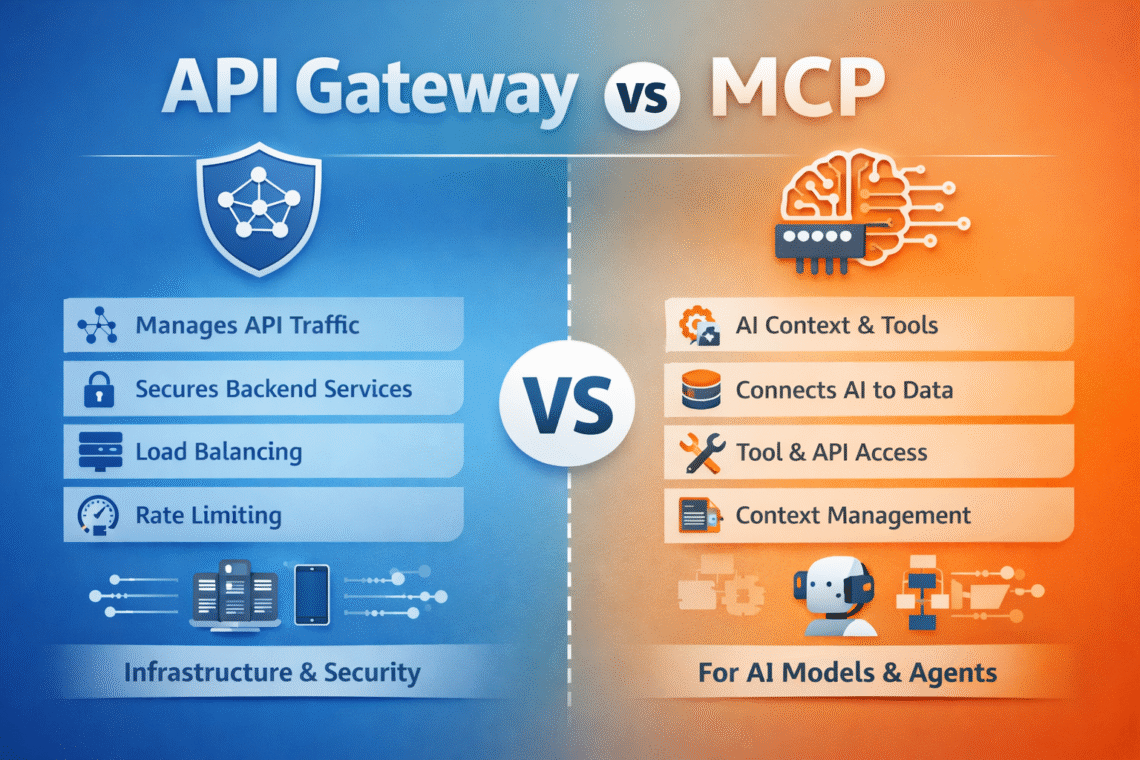
As modern applications move toward microservices, cloud-native architecture, and AI-powered systems, new infrastructure patterns are emerging alongside traditional ones. Two such important concepts are API Gateway and MCP (Model Context Protocol).
While both often appear in discussions around modern platforms, they serve very different purposes.
In this article, we’ll explore:
- What an API Gateway is
- What MCP is
- Why modern applications need both
- The key differences between API Gateway and MCP
- Real-world use cases for each
Let’s simplify it.
What Is an API Gateway?
An API Gateway is a central entry point that manages all incoming API requests to your backend services.
Instead of clients calling multiple microservices directly, they communicate with a single API Gateway that routes requests, applies security rules, and manages traffic.
Core features of an API Gateway
- API routing and load balancing
- Authentication and authorization (OAuth, JWT, API keys)
- Rate limiting and throttling
- Request transformation
- Logging and monitoring
- API versioning and governance
In short, an API Gateway acts as the traffic controller and security layer for your microservices.
Why API Gateways matter
Without an API Gateway:
- Clients become tightly coupled to backend services
- Security is duplicated across services
- Scaling and versioning become complex
- Operational visibility is reduced
This is why API Gateways are foundational in microservices architecture, cloud platforms, and enterprise integration.
What Is MCP (Model Context Protocol)?
MCP (Model Context Protocol) is a newer concept designed for the AI era.
It defines a standard way for AI models and agents to access tools, APIs, data, and system context safely and consistently.
Large language models don’t naturally know:
- What internal tools exist
- How to call APIs correctly
- Which data they’re allowed to access
- How to structure responses for systems
MCP solves this by creating a structured contract between AI models and the systems they interact with.
What MCP enables
- AI tool discovery and invocation
- Secure AI access to enterprise data
- Standardized context and input/output formats
- Interoperability between AI systems and applications
- Scalable AI agent orchestration
Think of MCP as the API Gateway for AI reasoning, not for traffic.
Why Modern Platforms Need Both
| Need | Solved by |
|---|---|
| Secure API traffic | API Gateway |
| Scalable backend communication | API Gateway |
| AI access to tools and data | MCP |
| Structured AI context | MCP |
| AI-system interoperability | MCP |
They operate at different layers:
- API Gateway → Infrastructure & networking layer
- MCP → Intelligence & AI orchestration layer
This means modern platforms, especially AI-powered SaaS products, copilots, and intelligent enterprise systems, benefit from both.
API Gateway vs MCP: Key Differences
| Feature | API Gateway | MCP |
|---|---|---|
| Primary purpose | Manage API traffic | Manage AI context and tools |
| Designed for | Microservices and clients | AI models and agents |
| Focus | Networking, security, routing | Intelligence, reasoning, integration |
| Protocols | HTTP, REST, gRPC | JSON-based structured contracts |
| Used by | Developers, DevOps teams | AI engineers, platform architects |
Use Cases
API Gateway Use Cases
- Mobile and web application backends
- Microservices-based platforms
- Public and partner APIs
- SaaS products with high traffic
- Enterprise integration systems
MCP Use Cases
- AI assistants connected to business systems
- Customer support copilots
- Autonomous AI agents
- AI-powered analytics and operations
- Intelligent developer tools
Real-World Scenario
Imagine a cloud-based e-commerce platform:
- The frontend communicates with backend services through an API Gateway.
- A customer support AI assistant uses MCP to access order status, refund tools, and customer history.
The API Gateway ensures security, scalability, and performance.
MCP ensures the AI understands what tools exist and how to use them correctly.
Together, they create a secure, scalable, and intelligent platform.
Final Thoughts
API Gateway and MCP are not competitors — they are complementary.
- API Gateway is essential for managing modern distributed systems.
- MCP is essential for enabling intelligent, AI-driven systems.
As software continues evolving toward intelligent platforms, the combination of cloud infrastructure + microservices + AI orchestration becomes the standard.
And in that world, API Gateway and MCP together form the backbone of scalable, secure, and intelligent applications.


