Microservices architecture is all about breaking down a large application into smaller, independent services that can communicate with each other. This approach helps in scalability, flexibility, and easier maintenance. However, designing microservices effectively requires certain patterns to manage communication, data, and failures efficiently.
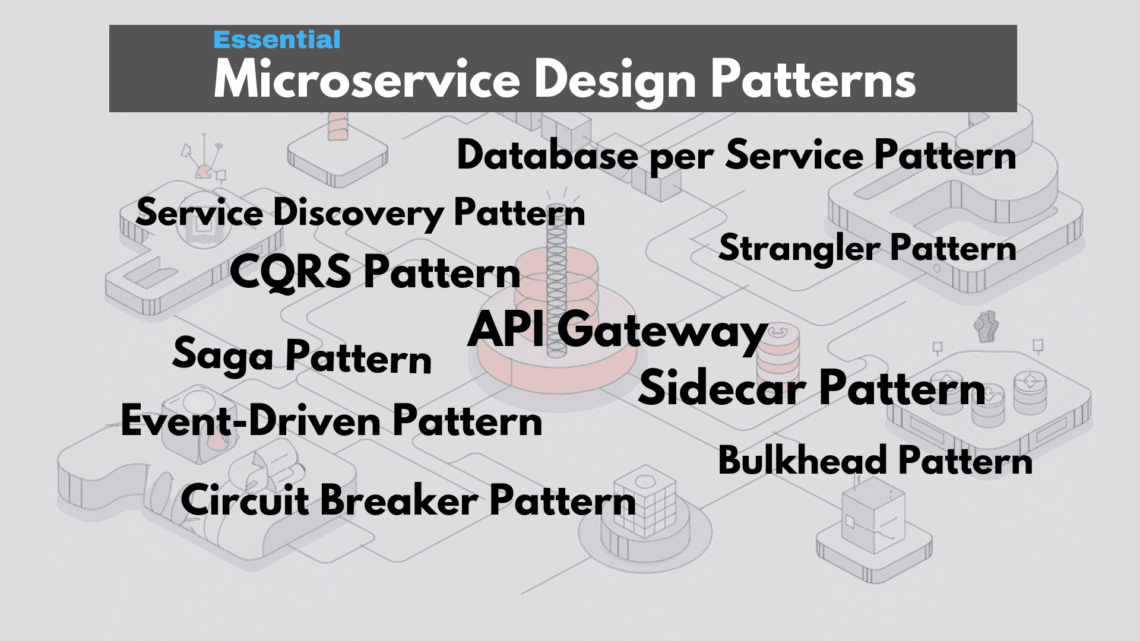
Here are some essential microservice design patterns to help you build resilient, high-performing systems.
1. API Gateway Pattern 🚦
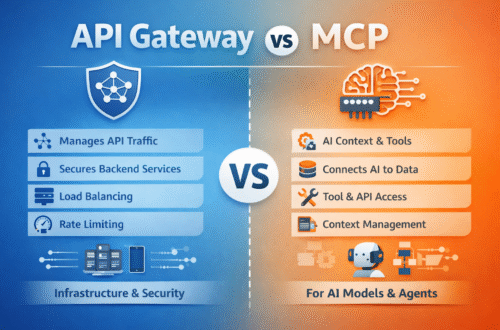
Think of an API Gateway as the front door to your microservices. Instead of clients communicating with multiple services directly, they interact with the API Gateway, which routes requests, handles security, and enforces policies like rate limiting and authentication.

✅ Pros:
- Simplifies client communication by exposing a single endpoint instead of multiple microservices.
- Handles authentication, authorization, and security in one place, so each service doesn’t need to implement it separately.
- Supports request aggregation, meaning a single request can pull data from multiple microservices and return a unified response.
- Can help with rate limiting and throttling to prevent overload on services.
❌ Cons:
- If the gateway goes down, all requests fail unless you have failover mechanisms in place.
- Introduces latency, as requests have to go through an extra hop before reaching the actual microservice.
- Can become a bottleneck if not properly optimized.
🔧 Popular Tools for API Gateway:
- Kong API Gateway (Lightweight, scalable, and widely used in production)
- NGINX (Fast and reliable for routing)
- AWS API Gateway (Great for cloud-native applications)
2. Service Discovery Pattern 🗺️
Since microservices are dynamic (they scale up and down), they need a way to find and communicate with each other without hardcoding addresses. Service Discovery helps services register themselves in a directory and allows other services to find them dynamically.

✅ Pros:
- It can move, scale, or restart without breaking connections.
- If one instance of a service fails, the discovery system finds a replacement automatically.
- It supports resilience and self-healing architectures
- It helps distribute traffic efficiently by choosing the best available instance.
❌ Cons:
- It requires additional infrastructure and management.
- It may introduce slight delays during service lookup.
- If the discovery service itself fails, microservices might not find each other.
🔧 Popular Tools for Service Discovery Pattern:
- Consul – A powerful and widely used service registry with health checks.
- Eureka – Used by Netflix for service discovery in its microservices ecosystem.
- Zookeeper – Originally for distributed applications, but widely used for service discovery.
- Etcd – A key-value store for service discovery, often used with Kubernetes.
- Kubernetes Service Discovery – Automatically discovers and manages services in Kubernetes cluster.
3. Circuit Breaker Pattern ⚡🔌
Imagine you keep calling a failing service repeatedly—it wastes resources and slows down the system. The Circuit Breaker pattern stops repeated requests to a failing service and allows it to recover before retrying, just like an electrical circuit breaker prevents damage from overloads.

✅ Pros:
- It prevents system-wide crashes by stopping calls to failing services.
- It improves response time by avoiding long wait times for failed services.
- It reduces unnecessary retries, preventing overload on a struggling service.
- It supports graceful degradation, allowing fallback mechanisms like cached data or alternate services.
❌ Cons:
- It adds complexity in tuning the failure threshold and recovery mechanism.
- Incorrect configurations can lead to unnecessary service blockages.
- It requires constant monitoring and fine-tuning.
- Sometimes, a temporary network glitch can trigger the circuit breaker unnecessarily.
🔧 Popular Tools for Circuit Breaker Pattern:
- Istio – Implements circuit breakers at the service mesh level.
- Envoy – A proxy that supports circuit breaking in microservices.
4. Database per Service Pattern 📦
Each microservice manages its own database to ensure independence and avoid bottlenecks. This prevents shared database conflicts but introduces challenges in managing distributed data.

✅ Pros:
- It ensures true independence—services can be developed, deployed, and scaled separately.
- It prevents a single point of failure—if one service’s database crashes, others continue running smoothly.
- It allows each microservice to choose the best database type for its needs (e.g., SQL for structured data, NoSQL for flexible storage).
❌ Cons:
- Handling data consistency is tricky since there’s no single database to manage transactions.
- Cross-service queries are difficult—if one service needs data from another, it has to call an API instead of running a simple SQL query.
- More complex database management—monitoring and maintaining multiple databases can be challenging.
🔧 Popular Tools for Database per Service Pattern:
- PostgreSQL, MySQL, MongoDB, Cassandra (For individual microservices)
- Kafka (Event-driven communication between databases)
5. Event-Driven Pattern ⚡📡
Instead of calling each service directly, microservices communicate via events. When something significant happens, an event is published, and other services can react to it asynchronously.

✅ Pros:
- It improves decoupling between services.
- It enhances scalability and responsiveness.
- It is great for real-time analytics, notifications, and event tracking.
- If one service is down, events can be retried later without breaking the system.
❌ Cons:
- Debugging and monitoring can be challenging.
- Since updates happen asynchronously, ensuring consistency requires extra effort.
- Services may receive the same event multiple times.
🔧 Popular Tools for Event-Driven Pattern:
- Kafka – Distributed event streaming for large-scale applications.
- RabbitMQ – Message broker for event-driven communication.
- AWS SNS + SQS – Cloud-based event messaging system.
- Google Pub/Sub – Real-time messaging for cloud applications.
- Azure Event Grid – Serverless event-based communication.
6. Saga Pattern 📖
Handling transactions across multiple microservices can be tough. The Saga pattern ensures data consistency by breaking a large transaction into smaller steps, each with a compensating action in case of failure.

✅ Pros:
- It maintains data consistency across distributed services
- It avoids complex distributed transactions
- It enables rollback in case of partial failures
❌ Cons:
- It requires a well-thought-out rollback mechanism to prevent inconsistent states.
- Debugging is complex—since transactions happen across multiple services, tracking failures is harder.
- It can lead to latency if too many services are involved.
🔧 Popular Tools for Saga Pattern:
- Kafka or RabbitMQ (For event-based transactions)
7. Strangler Pattern 🏗️🔄
The Strangler Pattern helps transition from a monolithic system to microservices step by step. Instead of rebuilding everything at once, it replaces parts of the old system with new microservices over time, making the migration smoother and less risky.

✅ Pros:
- It allows for step-by-step migration instead of a big-bang rewrite.
- The system remains operational while migrating.
- Teams can deliver improvements incrementally, showing progress faster.
- Each migration step is smaller and manageable, reducing technical debt.
- If something goes wrong, you can fallback to the monolith without major issues.
❌ Cons:
- It requires careful planning and execution.
- Ensuring data consistency across the old and new system is tricky.
- It may introduce performance overhead during migration.
- It requires to manage two architectures until the migration is complete.
🔧 Popular Tools for Strangler Pattern:
- API Gateway (Kong, NGINX, AWS API Gateway) – Helps route traffic to old and new services.
- Feature Flags (LaunchDarkly, ConfigCat) – Controls gradual rollouts and testing.
- Event-Driven Messaging (Kafka, RabbitMQ, AWS SNS/SQS) – Helps sync data between old and new components.
8. Bulkhead Pattern 🚢⚡
The Bulkhead Pattern divides services into isolated pools so that failure in one does not impact others, similar to compartments in a ship preventing it from sinking entirely.

✅ Pros:
- It helps maintain overall uptime and responsiveness.
- It prevents failures in one service from bringing down others.
- It ensures each service gets dedicated resources.
- Different parts of the system can scale independently.
❌ Cons:
- It increases system complexity due to resource segmentation.
- It Requires careful planning to determine boundaries.
- Some bulkheads might be idle while others are overloaded.
🔧 Popular Tools for Bulkhead Pattern:
- Istio & Envoy – Implements bulkhead isolation at the service mesh level.
- Kubernetes Resource Limits – Sets CPU & memory limits for microservices to prevent resource exhaustion.
9. CQRS (Command Query Responsibility Segregation) Pattern 📚✍️
The CQRS pattern separates read and write operations to optimize performance, scalability, and security.

✅ Pros:
- It improves performance by optimizing read and write workloads separately
- It enables better scalability, especially for applications with a heavy read-to-write ratio.
- It works well with event sourcing, where every state change is recorded.
❌ Cons:
- Increased complexity due to managing separate databases or models for reads and writes.
- It can require eventual consistency, meaning data might not be updated instantly.
🔧 Popular Tools for CQRS:
- Kafka or RabbitMQ (For propagating changes asynchronously)
- EventStoreDB (For event sourcing)
10. Sidecar Pattern 🦸
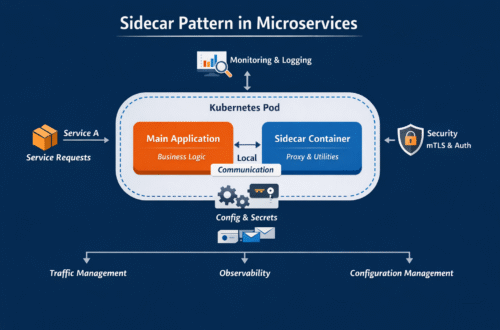
The Sidecar Pattern attaches helper services to a primary service to handle additional tasks like logging, monitoring, or networking, without modifying the main service.

✅ Pros:
- It offloads common concerns like logging, monitoring, and security to separate services.
- It keeps microservices lightweight and focused.
- It supports language-agnostic implementations.
❌ Cons:
- It increases infrastructure complexity—each microservice has an extra component to manage.
- It might introduce latency if too many sidecars are running.
🔧 Popular Tools for Sidecar Pattern:
- Istio (Service mesh that uses sidecars)
- Linkerd (Another service mesh option)
Closing Thoughts
The key to success isn’t just choosing the right patterns—it’s understanding when and how to use them. With a thoughtful approach, microservices can unlock agility, efficiency, and long-term stability, ensuring your system is built to handle growth and change with ease.
Thanks for reading!