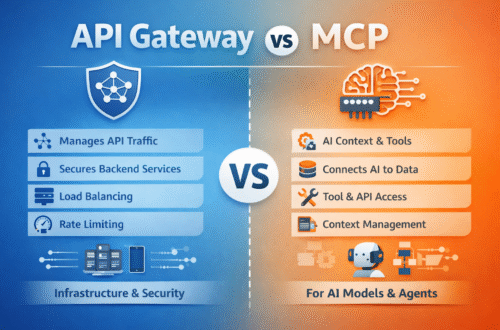
Overview
As AI models continue to improve, expectations from them are also increasing. Today, AI is expected not only to answer questions but to take action, integrate with systems, and operate within real business workflows. However, large language models are isolated by design — they don’t naturally know how to access files, call internal services, or work with enterprise data.
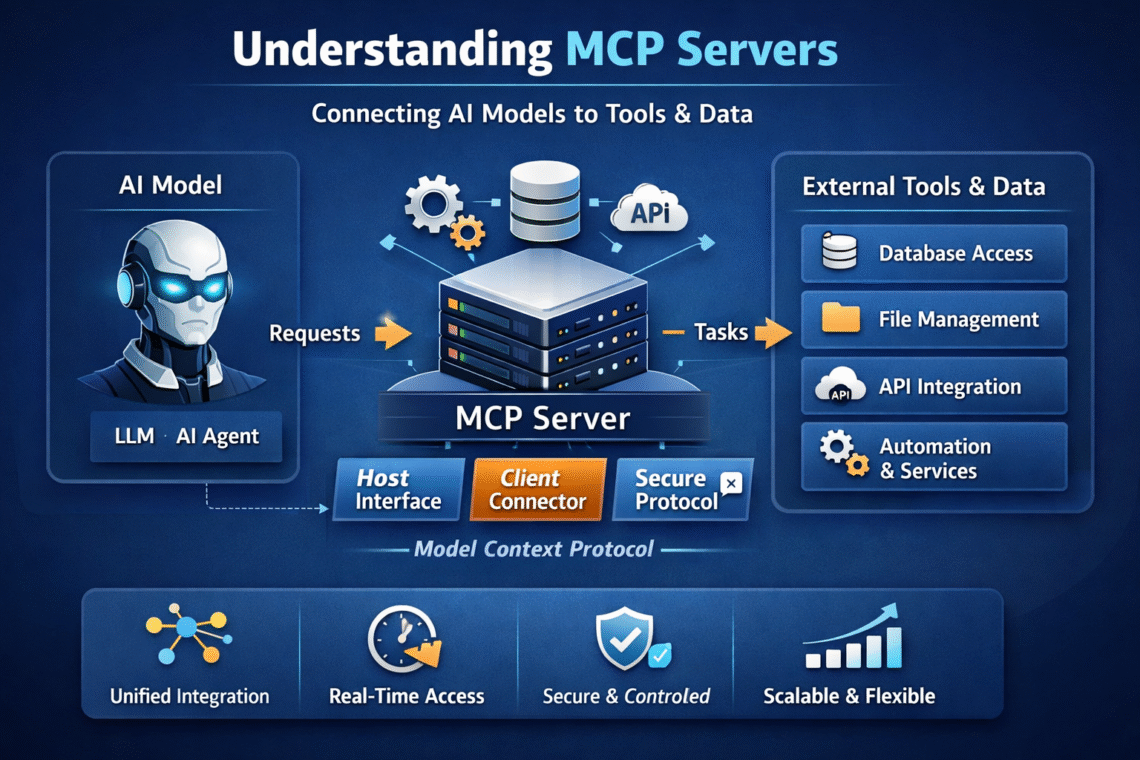
This gap is filled by MCP Servers. MCP (Model Context Protocol) introduces a structured and standardized way for AI models to communicate with external tools and data sources. MCP servers act as trusted intermediaries that translate AI intentions into real operations, while keeping control, security, and scalability intact.
In simple terms, MCP servers help AI move from thinking to doing.
What Is MCP (Model Context Protocol)?
Model Context Protocol is an open protocol designed to define how AI models interact with external capabilities. Instead of every AI application inventing its own integration logic, MCP provides a shared contract that both AI models and systems can understand.
MCP focuses on structured context rather than raw prompts. This includes:
- Available tools
- Input and output schemas
- Permissions and boundaries
- Execution responses
An MCP Server is the implementation that exposes these capabilities. It advertises what it can do, accepts structured requests, performs the requested action, and returns results in a predictable format.
Core Building Blocks of MCP
1. Host Application
The host is the user-facing AI application — such as a chatbot, agent platform, or internal assistant. It manages conversations and user intent.
2. MCP Client
The MCP client translates AI intent into protocol-compliant requests. It handles tool discovery, request formatting, and response parsing.
3. MCP Server
The MCP server executes the actual work. It exposes tools, enforces rules, validates inputs, performs operations, and returns structured responses.
This separation keeps responsibilities clear and systems maintainable.
Why MCP Is Needed
Without MCP, AI integrations often rely on tightly coupled APIs and custom logic. Over time, this approach leads to fragile systems that are hard to scale and secure.
MCP is needed because it:
- Eliminates repetitive integration work
- Allows tools to be reused across multiple AI models
- Reduces coupling between AI and backend systems
- Introduces clear governance and access control
- Supports future AI models without rewriting integrations
For growing products and enterprises, MCP provides a future-proof integration layer.
What Is the Use of an MCP Server?
MCP servers enable AI systems to interact with the real world in a controlled way.
Tool Execution
AI can request specific actions like reading data, updating records, generating artifacts, or triggering processes.
Context Sharing
They provide structured, up-to-date context that improves response accuracy and relevance.
Workflow Orchestration
Multiple tools can be combined into intelligent workflows, coordinated by AI reasoning.
Secure Enterprise Access
Internal systems can be exposed to AI without opening direct API access, reducing risk.
How MCP Helps AI Models
Makes AI Actionable
AI moves beyond text generation into real execution.
Improves Reasoning Quality
With access to live data and tools, AI decisions become more grounded and accurate.
Reduces Hallucination
Instead of guessing, AI can fetch authoritative data through MCP tools.
Enables Agent-Based Systems
MCP is a key enabler for autonomous and semi-autonomous AI agents.
Common Types of MCP Servers
Filesystem MCP Servers
Used for safe file access, content generation, configuration management, and document handling.
Source Control MCP Servers
Allow AI to read repositories, review changes, create commits, and assist with development workflows.
Memory MCP Servers
Provide long-term knowledge storage so AI can remember past interactions or learned information.
Data & Database MCP Servers
Enable querying structured data while enforcing schemas and permissions.
Web & Fetch MCP Servers
Allow controlled retrieval of external content without exposing unrestricted browsing.
Enterprise Integration MCP Servers
Custom servers built around CRMs, ERPs, analytics platforms, and internal services.
Popular MCP Servers
Here are some widely used MCP servers and resources you can reference on your site:
1. Official MCP Server Examples — GitHub
🔗 https://github.com/modelcontextprotocol/servers
A curated list of reference and community MCP server implementations spanning tools like file systems, version control, knowledge memory systems, and protocols in multiple languages.
2. Example MCP Server Collection
🔗 https://modelcontextprotocol.io/examples
Shows reference servers like Git (code repository tools), Filesystem (safe file operations), Fetch (web content tools), Memory (knowledge systems).
3. Awesome MCP Servers Community List
🔗 https://github.com/wong2/awesome-mcp-servers
A community-maintained mix of MCP server projects, including integrations like Airtable access and hub discovery servers.
4. Official MCP Registry
🔗 https://registry.modelcontextprotocol.io
Acts like an app store for MCP servers — browse and discover MCP servers publicly available for AI agents.
5. IBM MCP Servers
🔗 https://github.com/IBM/mcp
Multiple MCP servers built by IBM that expose cloud resources, infrastructure tools, security data, and more.
MCP in Real-World Architectures
In modern architectures, MCP servers typically sit between:
- AI models (cloud or local)
- Internal services
- External tools
They often integrate with authentication systems, logging pipelines, monitoring tools, and policy engines, making them suitable for production-grade deployments.
Why MCP Matters for the Future of AI
As AI systems evolve toward autonomous agents and decision-makers, standardized tool access becomes critical. MCP enables:
- Interoperability across AI platforms
- Consistent security enforcement
- Scalable AI ecosystems
- Faster innovation cycles
MCP servers are likely to become a default component in AI-first architectures.
Conclusion
MCP servers redefine how AI systems interact with the real world. By introducing a standardized, secure, and extensible protocol, MCP transforms AI from isolated models into practical, enterprise-ready systems.
For developers, MCP simplifies integrations.
For organizations, it reduces risk and accelerates adoption.
For AI models, it unlocks meaningful action.
If you are building serious AI products, MCP is no longer optional — it is foundational.