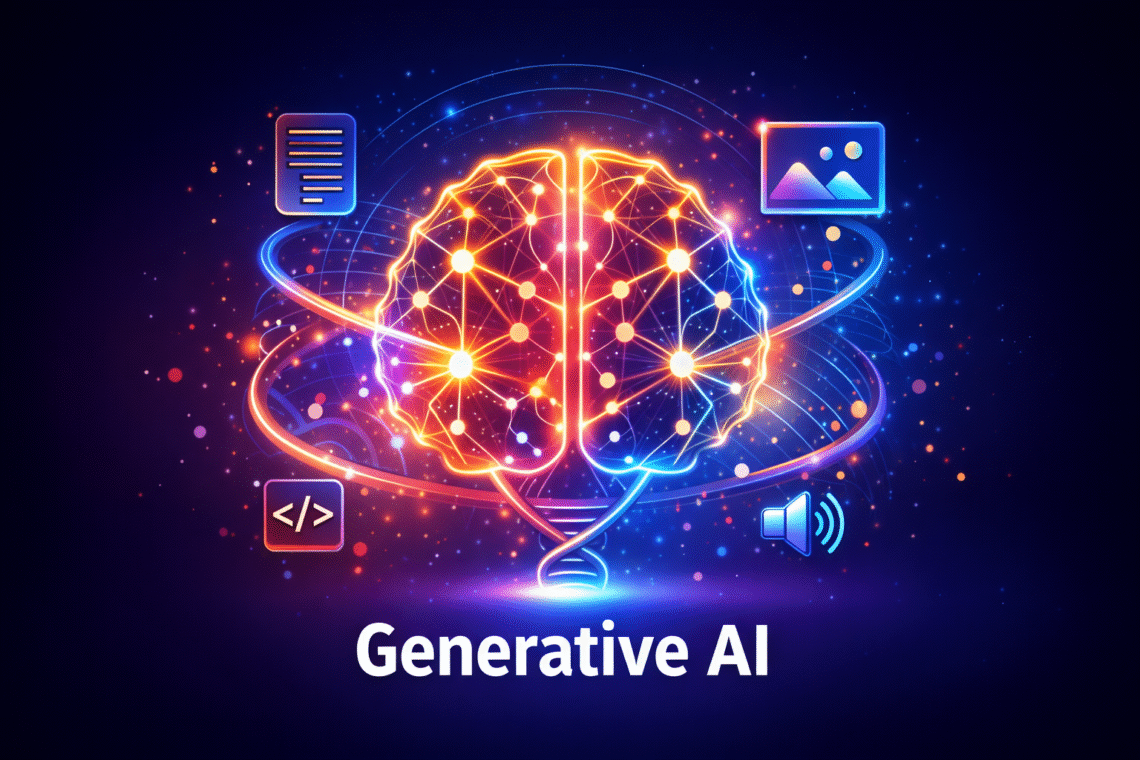
Generative AI is changing the way we create content, build software, design products, and interact with technology. From writing code and generating images to composing music and simulating human conversation, Generative Artificial Intelligence has become one of the most impactful innovations of the decade.
In this guide, we’ll explore what Generative AI is, how it works, its architecture, real-world use cases, benefits, limitations, and how businesses and developers are using it today.
What is Generative AI?
Generative AI refers to a class of artificial intelligence models that can create new content instead of just analyzing or classifying existing data.
It can generate:
- Text (articles, emails, code, chat responses)
- Images (art, product designs, logos)
- Audio (music, speech synthesis)
- Video (animations, simulations)
- 3D models and synthetic data
Unlike traditional AI, which focuses on predictions or classification, Generative AI focuses on creation.
How Generative AI Works
Generative AI models are trained on large datasets using deep learning techniques. These models learn patterns, structure, and relationships within data and use that knowledge to generate new, similar content.
Core Technologies Behind Generative AI
- Neural Networks
- Transformer Models
- Large Language Models (LLMs)
- Diffusion Models (for images and video)
- Variational Autoencoders (VAEs)
- Reinforcement Learning with Human Feedback (RLHF)
High-Level Architecture of a Generative AI System
Here’s a simple architecture flow:

Architecture Explanation
- User Input: The user provides a prompt or request.
- Prompt Processing: The system structures and validates the input.
- Foundation Model: The AI model generates content based on learned patterns.
- Safety & Filters: The output is filtered for quality, safety, and policy.
- Final Output: The result is delivered to the user.
Types of Generative AI Models
| Model Type | Purpose |
|---|---|
| LLMs | Text and code generation |
| Diffusion Models | Image and video creation |
| GANs | Realistic synthetic data |
| VAEs | Data compression and generation |
| Multimodal Models | Combine text, image, and audio |
Real-World Use Cases of Generative AI
1. Content Creation
- Blog writing
- Marketing copy
- Social media posts
2. Software Development
- Code generation
- Code review and debugging
- API documentation
3. Design and Creativity
- Graphic design
- Logo and UI generation
- Fashion and product modeling
4. Healthcare
- Medical image synthesis
- Drug discovery simulations
5. Business and Analytics
- Report generation
- Data summarization
- Customer support automation
Benefits of Generative AI
- Faster content production
- Reduced operational costs
- Increased creativity and innovation
- Automation of repetitive tasks
- Enhanced user experiences
Challenges and Limitations
- Data bias and hallucinations
- Intellectual property concerns
- Ethical and privacy risks
- High computational cost
- Dependence on quality training data
Generative AI vs Traditional AI
| Feature | Traditional AI | Generative AI |
|---|---|---|
| Output | Predictions | New content |
| Creativity | No | Yes |
| Learning | Pattern recognition | Pattern creation |
| Adaptability | Limited | High |
Popular Generative AI Tools and Platforms
- OpenAI Models
- Google Gemini
- Meta LLaMA
- Stable Diffusion
- Midjourney
- Runway
- Hugging Face
Future of Generative AI
The future of Generative AI includes:
- Autonomous AI agents
- Real-time personalized content
- AI-powered scientific discovery
- Fully multimodal human-AI interaction
Generative AI is evolving from a tool into a collaborative partner.
Conclusion
Generative AI is redefining how humans interact with machines. It empowers individuals and businesses to create, innovate, and scale faster than ever before. Whether you are a developer, entrepreneur, content creator, or researcher, understanding Generative AI is becoming essential in the digital age.