When working with text data in machine learning, one of the biggest challenges is how to represent words as numbers. Computers don’t understand language the way we do—they need numerical input. That’s where text representation techniques come in.
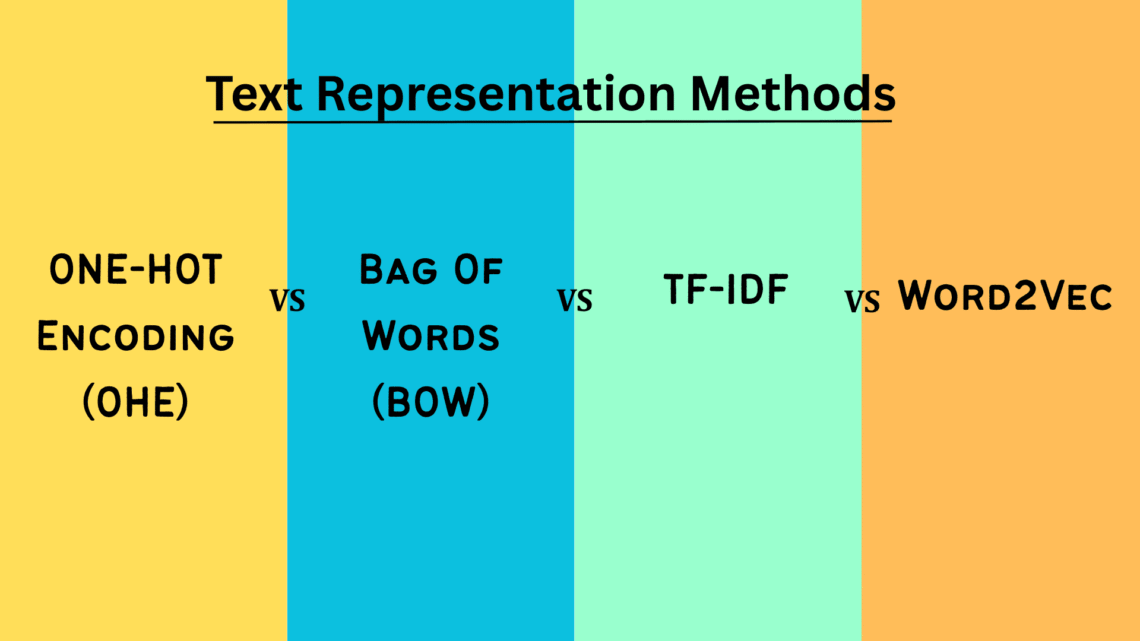
Today, we’ll walk through four of the most common approaches: One-Hot Encoding, Bag of Words, TF-IDF, and Word2Vec. By the end, you’ll know what each method does, where it works best, and when to move on to something more advanced.
1. One-Hot Encoding (The Starting Point)
Imagine you have three words: cat, dog, and fish. With one-hot encoding, each word gets a unique binary vector:
cat→ [1, 0, 0]dog→ [0, 1, 0]fish→ [0, 0, 1]
✅ Pros:
- Simple and easy to understand.
- Good for very small vocabularies.
❌ Cons:
- Doesn’t capture meaning—
catanddogare just as unrelated ascatandcarrot. - Leads to huge sparse vectors for large vocabularies (imagine having 50,000 words!).
📌 When to use: Only for very simple problems or when working with toy datasets
2. Bag of Words (BoW)
Now imagine we have a small document:
“Cats and dogs are friends. Dogs are loyal.”
With Bag of Words, we count how many times each word appears.
| Word | Count |
|---|---|
| cats | 1 |
| dogs | 2 |
| are | 2 |
| friends | 1 |
| loyal | 1 |
✅ Pros:
- Easy to implement and works surprisingly well for small tasks.
- Preserves word frequency information.
❌ Cons:
- Still doesn’t capture meaning.
- Ignores grammar and word order (“dog bites man” vs “man bites dog” look the same!).
- Large vocabularies lead to very high-dimensional vectors.
📌 When to use: Great for quick text classification tasks like spam detection.
3. TF-IDF (Term Frequency – Inverse Document Frequency)
Bag of Words treats all words equally, but let’s be honest—not all words are important. Words like “the”, “is”, and “are” show up everywhere but don’t tell us much.
That’s where TF-IDF helps. It boosts words that are unique to a document and downplays common ones.
Example:
- In movie reviews, “excellent” or “terrible” would have a higher weight than “the” or “and”.
✅ Pros:
- Smarter than raw counts—gives more importance to meaningful words.
- Still easy to compute and widely used.
❌ Cons:
- Still bag-based (no sense of word order).
- Vocabulary can still get large and sparse.
📌 When to use: Works well for search engines, document similarity, and text classification when context is less critical.
4. Word2Vec (Learning Word Meanings)
Now we step into the world of word embeddings. Unlike BoW or TF-IDF, Word2Vec learns the meaning of words by looking at their context.
For example:
- Words like “king” and “queen” will end up close together in vector space.
- Even cooler: king – man + woman ≈ queen.
✅ Pros:
- Captures semantic meaning and relationships between words.
- Dense, low-dimensional vectors (much smaller than BoW/TF-IDF).
- Makes downstream models much more powerful.
❌ Cons:
- Needs more data and training time.
- More complex to implement than BoW or TF-IDF.
📌 When to use: Perfect for NLP tasks like sentiment analysis, chatbots, translations, and anything where word meaning matters.
Quick Comparison Table
| Method | Captures Meaning? | Vector Size | Complexity | Best For |
|---|---|---|---|---|
| One-Hot | ❌ No | Huge | Easy | Simple toy problems |
| Bag of Words | ❌ No | Large | Easy | Quick text classification |
| TF-IDF | ❌ No | Large | Moderate | Search, document ranking |
| Word2Vec | ✅ Yes | Small | Higher | Advanced NLP tasks |
Final Thoughts
If you’re just starting, Bag of Words or TF-IDF is usually enough to get decent results. But if you want models that understand context and meaning, Word2Vec (or newer models like GloVe, FastText, or BERT) is the way forward.
Think of it like this:
- One-Hot → Baby steps.
- BoW → First bicycle.
- TF-IDF → A geared cycle.
- Word2Vec → A car 🚗.
The tool you choose depends on your task, data size, and goals.
Thanks for reading!