Modern applications are no longer built as one massive block of code. Instead, they are broken into smaller, independent services that work together — a concept known as microservices architecture. While microservices bring flexibility and scalability, they also introduce new challenges such as service communication, observability, security, and configuration management.
This is where the Sidecar Pattern comes into play.
In this blog, we’ll explore:
- What microservices architecture is
- What the Sidecar pattern means
- How and why the Sidecar pattern is used
- Its advantages and disadvantages
- Popular sidecar solutions available today.
What Is Microservices Architecture?
Microservices architecture is a design approach where an application is composed of multiple small, independent services. Each service:
- Focuses on a single business capability
- Can be developed, deployed, and scaled independently
- Communicates with other services over lightweight protocols (HTTP, gRPC, messaging)
Key benefits of microservices:
- Faster development and deployment
- Better scalability
- Technology flexibility
- Improved fault isolation
However, as the number of services grows, managing cross-cutting concerns becomes complex.
What Are Cross-Cutting Concerns?
Cross-cutting concerns are functionalities that are required by almost every service, such as:
- Logging
- Monitoring and metrics
- Service discovery
- Authentication and authorization
- Configuration management
- Retry, timeout, and circuit breaking
- Secure communication (mTLS)
Embedding these features directly into each microservice leads to:
- Code duplication
- Increased maintenance cost
- Tight coupling with infrastructure libraries
This is exactly the problem the Sidecar Pattern solves.
What Is the Sidecar Pattern?
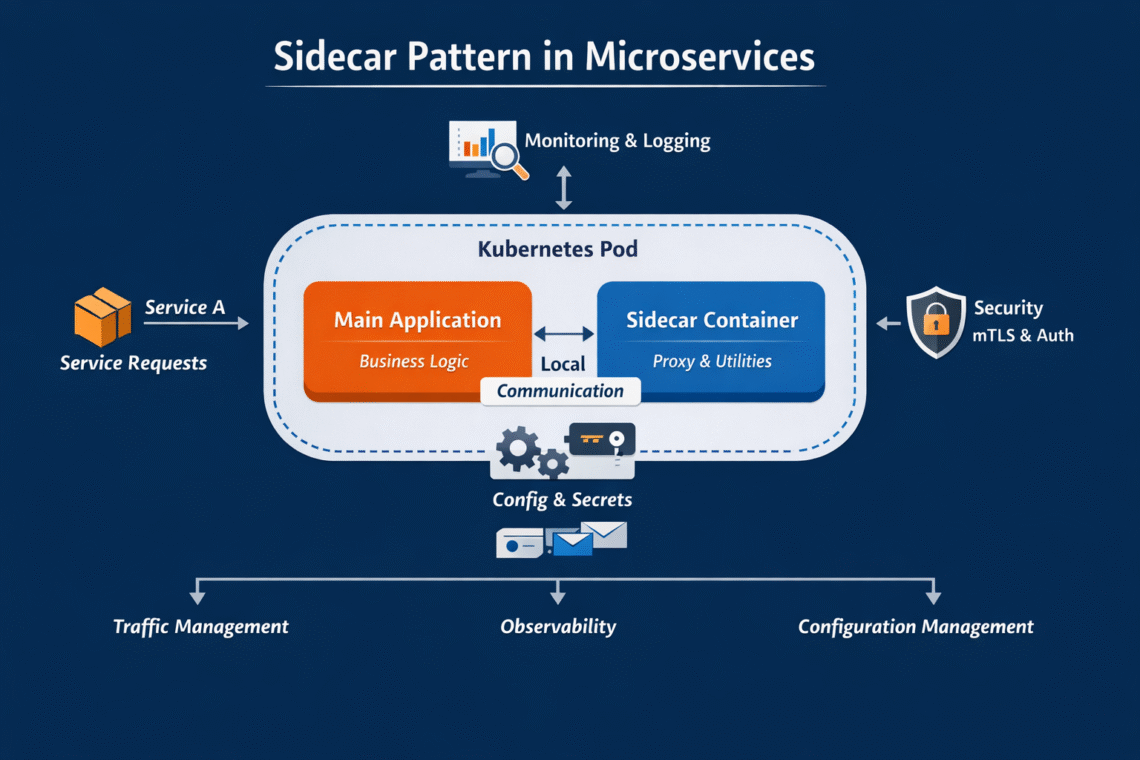
The Sidecar Pattern is a microservices design pattern where a separate helper component (the sidecar) runs alongside a primary application service.
Think of it like this:
Your main service focuses purely on business logic, while the sidecar handles infrastructure and operational concerns.
The sidecar:
- Runs in the same environment as the service (often the same pod in Kubernetes)
- Communicates with the main service via localhost
- Is deployed, updated, and scaled together with the main service
How the Sidecar Pattern Works
In a typical setup:
- Each microservice instance has its own sidecar
- The application sends requests to the sidecar instead of handling infrastructure logic itself
- The sidecar takes care of communication, security, retries, logging, or metrics
This keeps the core service clean and lightweight.
Why Use the Sidecar Pattern?
The Sidecar pattern is used to offload non-business responsibilities from microservices.
Common use cases:
- Service-to-service communication
- Distributed tracing and logging
- Metrics collection
- Security (mTLS, token validation)
- Rate limiting and retries
- Configuration and secrets management
Advantages of the Sidecar Pattern
1. Clean Separation of Concerns
Business logic stays inside the service, while infrastructure logic lives in the sidecar.
2. Reusable Infrastructure Logic
The same sidecar can be reused across multiple services, reducing duplication.
3. Technology Independence
Services can be written in any language, while the sidecar handles common features.
4. Improved Observability
Logging, tracing, and metrics can be standardized across all services.
5. Easier Maintenance
Infrastructure changes can be made in the sidecar without touching application code.
Disadvantages of the Sidecar Pattern
While powerful, the Sidecar pattern is not without trade-offs.
1. Increased Resource Usage
Each service instance runs an additional process, consuming CPU and memory.
2. Operational Complexity
Managing and monitoring sidecars adds operational overhead.
3. Latency Overhead
Extra network hops between service and sidecar may introduce small latency.
4. Debugging Challenges
When something goes wrong, you must debug both the service and its sidecar.
When NOT to Use the Sidecar Pattern
Although powerful, the Sidecar pattern isn’t always the right choice.
You may want to avoid it when:
- Your application is very small or short-lived
- Infrastructure concerns are minimal
- Resource usage must be extremely optimized
- You don’t need advanced observability or security features
In such cases, a simple library-based approach may be sufficient.
Popular Sidecar Solutions in the Market
Several platforms implement the Sidecar pattern effectively.
Dapr (Distributed Application Runtime)
Dapr is one of the most popular sidecar-based runtimes for microservices.
Key features of Dapr:
- Service invocation
- State management
- Publish/subscribe messaging
- Secrets management
- Distributed tracing and metrics
- Works with HTTP and gRPC
- Language-agnostic
With Dapr, developers interact with APIs instead of complex infrastructure components.
Service Mesh Sidecars (Envoy-based)
Service meshes like Istio, Linkerd, and Consul use sidecars extensively.
Typical capabilities:
- Traffic routing
- mTLS security
- Load balancing
- Circuit breaking
- Observability
These sidecars are usually transparent to the application.
Sidecar Pattern vs Library-Based Approach
| Aspect | Sidecar Pattern | Library Approach |
|---|---|---|
| Language dependency | Language-agnostic | Language-specific |
| Code duplication | Minimal | High |
| Operational control | Centralized | Distributed |
| Resource usage | Higher | Lower |
| Flexibility | High | Medium |
When Should You Use the Sidecar Pattern?
The Sidecar pattern is a great choice when:
- You have a growing microservices ecosystem
- You want consistent observability and security
- Multiple teams work on different services
- You want to avoid coupling business logic with infrastructure code
It may be overkill for very small systems or simple applications.
Conclusion
The Sidecar Pattern is a powerful microservices architecture pattern that helps teams manage complexity by separating business logic from infrastructure concerns. Tools like Dapr and service mesh solutions have made sidecars easier to adopt and operate at scale.
If you’re building modern, cloud-native applications and want cleaner code, better observability, and improved scalability, the Sidecar pattern is definitely worth considering.