Writing software is not just about making things work — it is about making them easy to understand, easy to change, and safe to grow. As applications become larger and more complex, small design mistakes can turn into big problems like bugs, slow development, and high maintenance costs.
That is why developers follow software design principles. These principles act as guidelines that help us build software that is clean, flexible, and reliable over time.
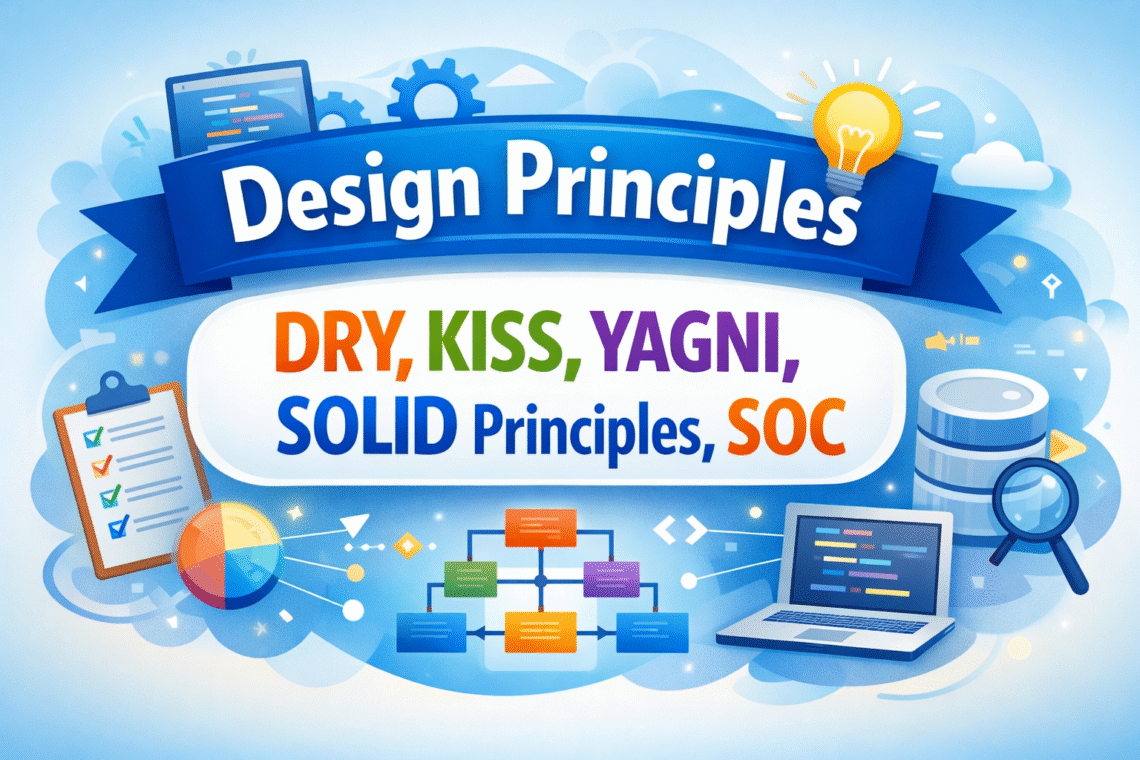
In this article, we will clearly explain the most important design principles:
DRY, KISS, YAGNI, SOLID Principles, and Separation of Concerns (SoC) — with simple explanations and real-world examples.
What Are Software Design Principles?
Software design principles are best practices and guidelines that help developers structure code and systems in a better way. They are not strict rules, but helpful ideas that guide decisions when writing or designing software.
They help ensure that software is:
- Easy to understand
- Easy to modify
- Easy to test
- Easy to scale
Why Do We Need Design Principles?
Without design principles, software tends to become:
- Hard to change
- Full of duplicated and messy code
- Risky to modify because changes break other parts
- Expensive and slow to maintain
With good design principles:
- Code becomes cleaner and more organized
- Bugs are easier to fix
- Teams can work faster and more confidently
- Systems remain healthy as they grow
The Core Design Principles
1. DRY — Don’t Repeat Yourself
Meaning:
Do not write the same logic in multiple places.
Why it matters:
If the same logic exists in many places, changing it becomes difficult and error-prone.
Simple Example:
Instead of repeating validation rules in multiple files, place them in a shared service and reuse it.
Result:
By following DRY, you reduce duplication and prevent inconsistencies. When a rule changes, you update it in one place, which reduces bugs and makes maintenance much easier.
2. KISS — Keep It Simple, Stupid
Meaning:
Keep solutions simple and easy to understand.
Why it matters:
Complex systems are harder to debug, test, and explain to others.
Simple Example:
Avoid using complex patterns when a simple function is enough.
Result:
Simple code is easier to read, easier to debug, and easier for new developers to understand. This improves reliability and reduces development time.
3. YAGNI — You Aren’t Gonna Need It
Meaning:
Do not build features until they are actually needed.
Why it matters:
Building future features without real demand leads to wasted effort and unnecessary complexity.
Simple Example:
Don’t build a plugin framework unless there is a clear requirement for plugins.
Result:
YAGNI helps teams deliver faster, keep systems simple, and avoid spending time on unused features.
4. SOLID Principles
SOLID is a set of five object-oriented design principles:
| Letter | Principle | Simple Explanation |
|---|---|---|
| S | Single Responsibility | One class should do one job |
| O | Open/Closed | Extend behavior without changing existing code |
| L | Liskov Substitution | Subtypes should replace parent types safely |
| I | Interface Segregation | Avoid large, unnecessary interfaces |
| D | Dependency Inversion | Depend on abstractions, not implementations |
Result:
SOLID makes systems modular, testable, flexible, and easier to extend without breaking existing behavior.
5. Separation of Concerns (SoC)
Meaning:
Split a system into parts where each part has a clear responsibility.
Example Layers:
- Presentation (UI)
- Business Logic (Services)
- Data Access (Repositories)
Result:
SoC allows independent changes, better team collaboration, and cleaner system architecture.
How These Principles Are Used in Software Design
These principles influence decisions about:
- Code structure
- Architecture layers
- Dependency management
- Service boundaries
- Scalability
They are widely used in:
- Clean Architecture
- Microservices
- Layered architectures
- Modular front-end design
Differences Between the Principles
| Principle | Focus |
|---|---|
| DRY | Avoid duplication |
| KISS | Reduce complexity |
| YAGNI | Avoid overengineering |
| SOLID | Improve object-oriented design |
| SoC | Improve system structure |
Conclusion
DRY, KISS, YAGNI, SOLID Principles, and Separation of Concerns are practical tools that help developers build better software.
When applied correctly, they:
- Reduce bugs
- Improve code quality
- Make systems scalable and maintainable
- Enable faster and safer development
Great software is not just about writing code — it’s about designing it wisely.