When building a large-scale distributed system, choosing the right database is crucial for meeting both user expectations and business requirements. The CAP Theorem offers valuable insights into the trade-offs involved in selecting a database, especially when it comes to consistency, availability, and partition tolerance.
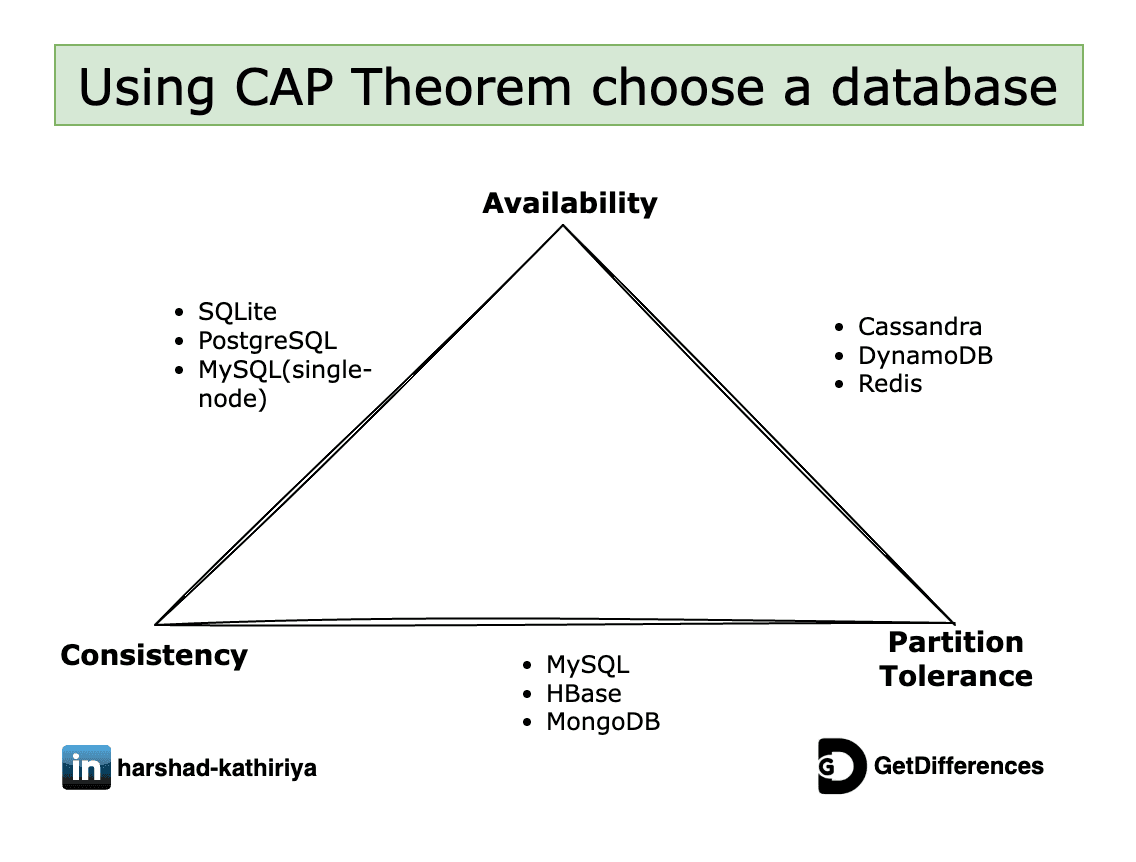
The CAP Theorem states that a distributed database system can only guarantee two out of the following three properties at any time:
- Consistency:Every read operation will return the most recent write, ensuring all users see the same data at the same time.
- Availability:Every request will receive a response (either success or failure), even if some of the system’s nodes are down.
- Partition Tolerance:The system will continue to function properly even when network partitions occur, meaning parts of the system can’t communicate with each other.
CAP Theorem Categories and Database Selection:
Consistency-Availability(CA)

- SQLiteSQLite is an in-process library that implements a self-contained, serverless, zero-configuration, transactional SQL database engine. You can find more information in the official documentation: https://www.sqlite.org/
- PostgreSQLPostgreSQL is an object-relational database management system (ORDBMS), developed at the University of California at Berkeley Computer Science Department. You can find more information in the official documentation: https://www.postgresql.org/docs/
- MySQL(single-node)MySQL in a single-node setup operates as a standalone instance, ensuring strong consistency and high availability within the limits of a single machine. You can find more information in the official documentation: https://dev.mysql.com/doc/
Availability-Partition Tolerance(AP)

- CassandraCassandra is a highly scalable, distributed NoSQL database designed to handle massive amounts of data across multiple nodes with no single point of failure. You can find more information in the official documentation: https://cassandra.apache.org/_/index.html
- DynamoDBDynamoDB is a fully managed NoSQL database service by AWS, designed for seamless scalability, low-latency performance, and high availability. You can find more information in the official documentation: https://docs.aws.amazon.com/dynamodb/
- RedisRedis is an in-memory key-value store known for its lightning-fast performance and versatility. It supports data structures like strings, hashes, lists, sets, and sorted sets, making it suitable for caching, session storage, real-time analytics, and messaging. You can find more information in the official documentation: https://redis.io/docs/latest/
Consistency-Partition Tolerance(CP)

- MySQLMySQL is a widely-used, open-source relational database that supports both single-node and distributed setups. You can find more information in the official documentation: https://dev.mysql.com/doc/
- HBaseHBase is a distributed, scalable, NoSQL database designed to handle large amounts of sparse data. Built on top of the Hadoop Distributed File System (HDFS), it provides strong support for availability and partition tolerance (AP) under the CAP theorem. You can find more information in the official documentation: https://hbase.apache.org/
- MongoDBMongoDB is a popular NoSQL database designed for flexibility, scalability, and ease of development. You can find more information in the official documentation: https://www.mongodb.com/docs/atlas/
Thanks for reading!