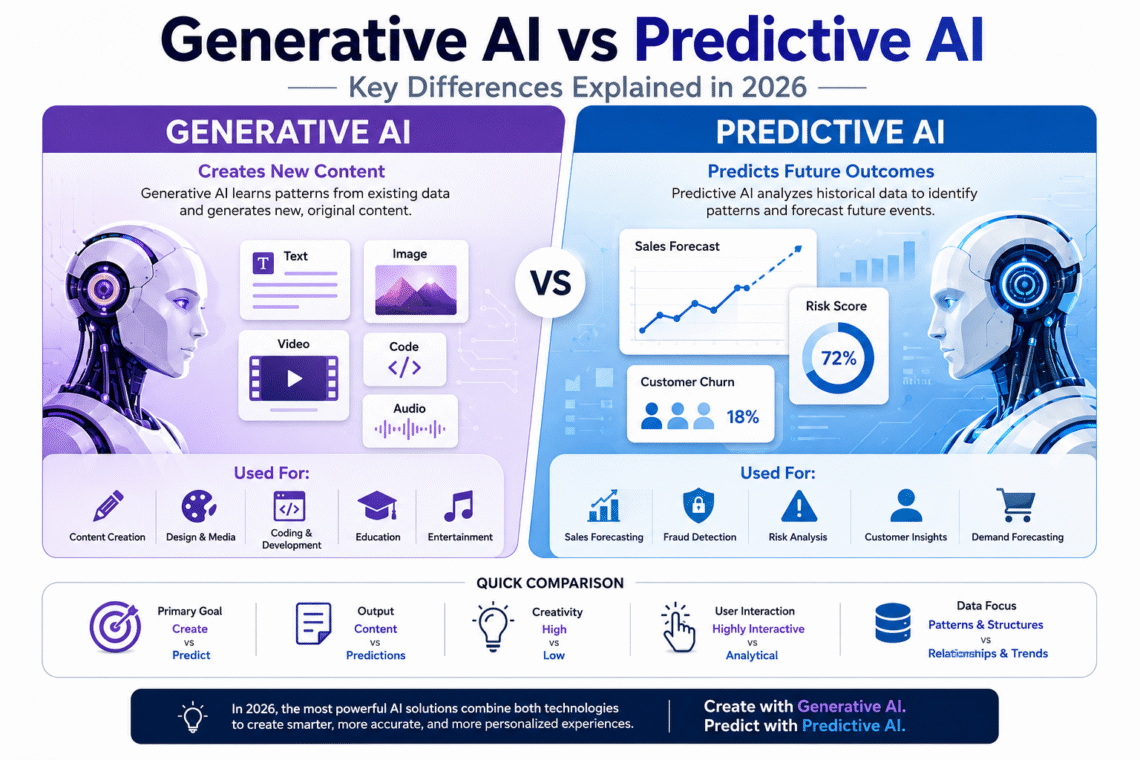
Artificial Intelligence has evolved rapidly over the past few years, and by 2026, two major branches of AI are driving innovation across industries: Generative AI and Predictive AI.
Although both technologies are powered by machine learning and data, they serve very different purposes. One creates new content, while the other forecasts future outcomes.
If you’ve ever wondered whether ChatGPT, AI image generators, recommendation engines, or fraud detection systems belong to the same category, this guide will help you understand the key differences between Generative AI and Predictive AI in simple terms.
What is Generative AI?
Generative AI is designed to create new content based on patterns learned from existing data.
Instead of simply analyzing information, it generates something original such as:
- Text
- Images
- Videos
- Music
- Code
- 3D models
- Voice recordings
Popular examples include AI chatbots, image generation tools, video creation platforms, and coding assistants.
Example
If you ask an AI:
“Create a futuristic city on Mars.”
A Generative AI model can produce an entirely new image or description that never existed before.
Main Goal
Generate new content that resembles human-created work.
What is Predictive AI?
Predictive AI focuses on forecasting future events or outcomes using historical data.
It examines patterns, trends, and relationships within data to estimate what is likely to happen next.
Predictive AI is commonly used in:
- Sales forecasting
- Stock market analysis
- Fraud detection
- Weather prediction
- Customer churn prediction
- Medical diagnosis support
- Demand forecasting
Example
A retail company may use Predictive AI to estimate:
“How many products will be sold next month?”
The model analyzes past sales trends and predicts future demand.
Main Goal
Predict future outcomes as accurately as possible.
Generative AI vs Predictive AI: Quick Comparison
| Feature | Generative AI | Predictive AI |
|---|---|---|
| Primary Purpose | Create new content | Forecast future outcomes |
| Output | Text, images, videos, code, audio | Predictions, probabilities, forecasts |
| Training Focus | Learning patterns and structures | Learning relationships between variables |
| User Interaction | Highly interactive | Mostly analytical |
| Creativity | High | Low |
| Business Use Cases | Content creation, design, coding | Forecasting, risk analysis, decision-making |
| Examples | AI chatbots, image generators | Fraud detection, sales forecasting |
| Outcome | Generates something new | Estimates what will happen |
How Generative AI Works
Generative AI models learn patterns from massive datasets.
For example, a language model studies billions of words from books, websites, and articles. It learns:
- Grammar
- Writing styles
- Context
- Relationships between words
When a user provides a prompt, the model predicts and generates the most relevant content based on what it learned.
In 2026, modern Generative AI systems can:
- Write articles
- Create realistic images
- Generate videos
- Build websites
- Produce software code
- Create digital avatars
The quality of generated content has improved dramatically, making AI-generated content nearly indistinguishable from human-created content in many situations.
How Predictive AI Works
Predictive AI uses historical data to identify patterns that can help estimate future events.
The process generally involves:
- Collecting historical data
- Cleaning and preparing data
- Training a predictive model
- Testing accuracy
- Generating future predictions
For example, a bank can train a model using:
- Customer income
- Credit history
- Spending patterns
- Loan repayment records
The system then predicts the likelihood of loan default for new applicants.
Unlike Generative AI, Predictive AI does not create new content. It simply estimates future probabilities.
Real-World Applications in 2026
Generative AI Applications
Content Creation
Marketing teams use AI to generate:
- Blog posts
- Social media content
- Product descriptions
- Advertising copy
Software Development
Developers use AI coding assistants to:
- Generate code
- Debug applications
- Create documentation
- Build prototypes faster
Design and Media
Designers create:
- Logos
- Illustrations
- Marketing visuals
- Video content
Education
Students and educators use AI for:
- Personalized learning materials
- Interactive tutoring
- Content summarization
Predictive AI Applications
Healthcare
Hospitals use Predictive AI to identify:
- Disease risks
- Patient deterioration
- Treatment effectiveness
Finance
Financial institutions predict:
- Credit risk
- Fraud attempts
- Market trends
Retail
Retailers forecast:
- Product demand
- Inventory requirements
- Customer purchasing behavior
Manufacturing
Manufacturers predict:
- Equipment failures
- Maintenance schedules
- Production bottlenecks
Can Generative AI and Predictive AI Work Together?
Absolutely.
Many modern AI systems combine both approaches.
Consider an e-commerce platform:
Predictive AI
- Predicts which products a customer is likely to purchase.
Generative AI
- Creates personalized product descriptions and marketing messages.
Together, they deliver a more personalized customer experience.
This hybrid approach is becoming increasingly common in 2026.
Advantages of Generative AI
Benefits
- Accelerates content creation
- Enhances creativity
- Reduces production costs
- Supports rapid prototyping
- Automates repetitive creative tasks
Challenges
- Hallucinations and inaccuracies
- Copyright concerns
- Deepfake misuse
- High computing costs
Advantages of Predictive AI
Benefits
- Improves decision-making
- Reduces business risks
- Enhances operational efficiency
- Supports strategic planning
- Delivers measurable business value
Challenges
- Depends heavily on data quality
- Predictions can become outdated
- Bias in training data may affect outcomes
- Requires ongoing monitoring and retraining
Which One is More Important in 2026?
The answer depends on your goals.
If you need to:
- Create content
- Generate images
- Build marketing materials
- Develop software faster
Generative AI is likely the better choice.
If you need to:
- Forecast sales
- Detect fraud
- Predict customer behavior
- Manage risk
Predictive AI is usually more suitable.
For many organizations, the greatest value comes from combining both technologies rather than choosing one over the other.
Final Thoughts
Generative AI and Predictive AI represent two powerful but fundamentally different approaches to artificial intelligence.
Generative AI creates.
Predictive AI forecasts.
While Generative AI is transforming how humans produce content, Predictive AI continues to help organizations make smarter decisions based on data.
As AI technology advances throughout 2026 and beyond, businesses that successfully integrate both approaches will be better positioned to innovate, improve efficiency, and deliver more personalized experiences.
Understanding the difference between these two AI models is the first step toward choosing the right solution for your specific needs.