
If you haven’t read our earlier blog, “What Is an AI Engineer?”, we recommend reading that first before continuing with this roadmap.
If you already understand what an AI Engineer is, the next question is simple:
👉 How do you actually become one?
A lot of advice online is still too vague, too academic, or too tool-driven. You see endless lists of courses, frameworks, and buzzwords, but not a clear path.
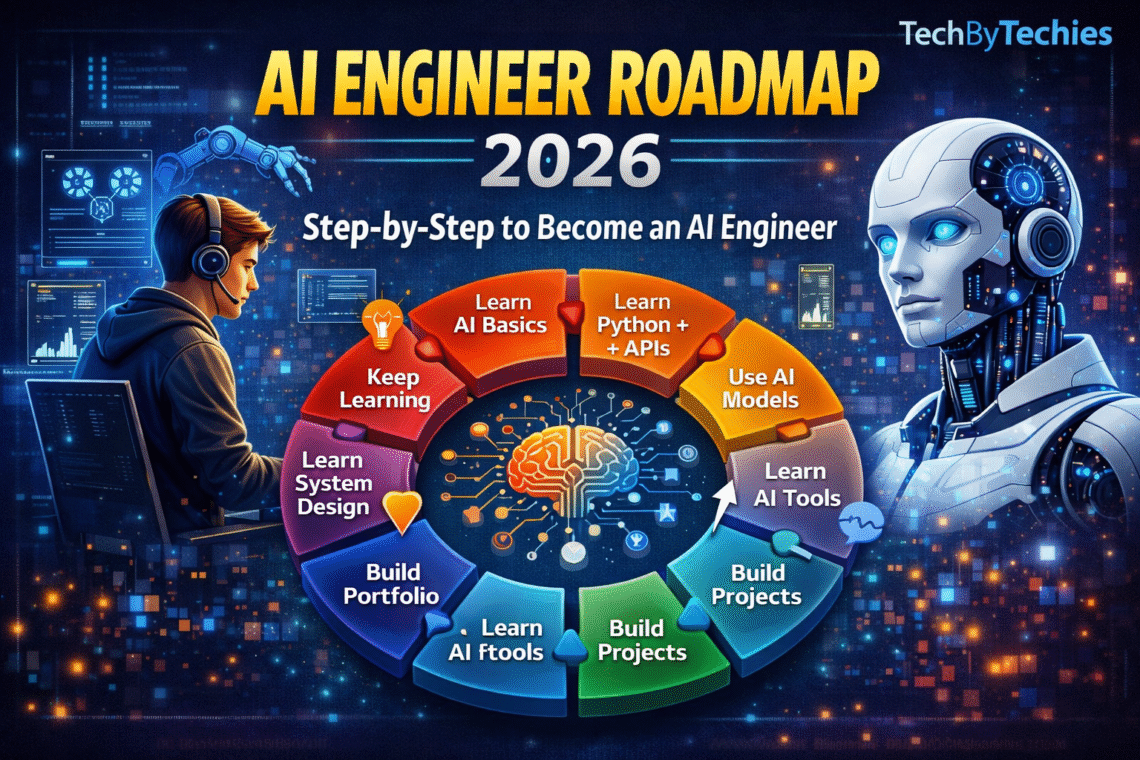
This roadmap is a practical guide to becoming an AI Engineer in 2026. It focuses on the skills that matter if your goal is to build real AI products, not just collect certificates or follow trends.
🚀 Who This Roadmap Is For
This roadmap is for:
- Developers moving into AI
- Beginners exploring AI careers
- Software engineers confused by the difference between AI Engineering, Machine Learning, and Data Science
- Builders who want to work on LLM apps, AI agents, automation tools, and AI-powered products
What AI Engineers Actually Do
Before the roadmap, it helps to be clear about the role.
In 2026, most AI Engineers are not training foundation models from scratch.
Instead, they usually:
- Use existing AI models through APIs or open-source tooling
- Build products on top of LLMs and other AI systems
- Connect models to data, tools, and business workflows
- Improve quality through evaluation, guardrails, and iteration
- Deploy, monitor, and scale AI features in production
That means AI Engineering sits between software engineering and applied AI.
It is less about pure research and more about building reliable AI systems people can actually use.
🧠 Step 1: Learn the Foundations First
Do not skip this step.
You do not need a deep research background to start, but you do need to understand the fundamentals well enough to make good engineering decisions.
Learn these core ideas:
- What machine learning is
- How large language models work at a high level
- The difference between training, fine-tuning, prompting, and retrieval
- Tokens, context windows, latency, and cost
- Basic data handling and APIs
You do not need advanced math on day one, but basic statistics, probability, and data intuition will help you a lot as you grow.
If your foundation is weak, every tool will feel confusing later.
💻 Step 2: Get Strong in Programming
AI Engineers are still engineers.
That means you need to be comfortable writing code, building APIs, debugging systems, and shipping features.
Core languages to focus on:
- Python
- JavaScript or TypeScript
Python is still the most important language in AI because so much of the ecosystem is built around it. JavaScript or TypeScript is useful if you want to build AI products for the web.
Skills to learn here:
- Working with APIs
- JSON and data processing
- Backend fundamentals
- Error handling
- Async workflows
- File handling
- Authentication basics
Useful frameworks include FastAPI, Flask, Node.js, and Express. The exact framework matters less than your ability to build and ship.
The main rule: build things early. Do not spend months watching tutorials without making anything.
🤖 Step 3: Learn How to Use Models Effectively
This is where AI Engineering starts to become its own discipline.
You are usually not building new models from scratch. You are learning how to use models well inside real systems.
Focus on:
- Calling LLM APIs
- Writing better prompts
- Structured outputs
- Tool calling and function calling
- Context management
- Model selection based on quality, speed, and cost
- When to use a larger model vs a smaller one
Prompt engineering still matters, but in 2026 it should be treated as one part of a larger engineering workflow, not as the whole job.
Good AI Engineers do not just write prompts. They design systems that make model behavior more reliable.
🧩 Step 4: Learn Retrieval and AI App Architecture
Many useful AI products are not powered by prompts alone.
They work because they connect models to the right context, data, and workflows.
Learn these concepts:
- Embeddings
- Semantic search
- Hybrid search
- Chunking
- Metadata filtering
- Reranking
- Retrieval-augmented generation (RAG)
You may use vector databases, Postgres with vector extensions, or other search infrastructure depending on the product. Do not get too attached to one tool.
The important thing is understanding how information is stored, retrieved, ranked, and passed to the model.
Frameworks such as LangChain, LangGraph, and LlamaIndex can be useful, but they are optional. Learn the concepts first so you are not dependent on a single abstraction.
🛠️ Step 5: Build Real Projects as Early as Possible
This is the step that changes everything.
The fastest way to become an AI Engineer is not by studying longer. It is by building sooner.
Good starter project ideas:
- AI chatbot with memory or retrieval
- AI document Q&A app
- Resume analyzer
- AI content assistant
- Customer support copilot
- AI search engine
- Internal workflow automation tool
What matters in a project:
- It solves a real problem
- It has a usable interface or API
- It handles messy real-world inputs
- It is deployed somewhere
- It can be explained clearly
A small real project teaches more than ten theoretical tutorials.
🛠️ Step 6: Learn Evaluation, Safety, and Reliability
This is the part many beginner roadmaps miss.
In 2026, AI Engineering is not just about getting a model to respond. It is about making that behavior dependable.
You should learn:
- How to create evals for prompts and workflows
- How to test model behavior against expected outputs
- How to catch regressions when prompts or models change
- How to add moderation and guardrails
- How to handle hallucinations and failure cases
- Basic prompt injection awareness
- When human review is necessary
If you want to work on serious AI products, this step is not optional.
Anyone can build a demo. Professionals build systems that can be tested, monitored, and improved.
☁️ Step 7: Learn Deployment and Production Thinking
A local demo is not the same thing as a production application.
AI Engineers need to think beyond “it works on my laptop.”
Learn:
- How to deploy APIs and web apps
- Hosting platforms such as Vercel, AWS, Railway, Render, or similar platforms
- Secrets management
- Logging and monitoring
- Rate limits and retries
- Background jobs and queues
- Cost tracking and optimization
When AI features go into production, cost, latency, and reliability become real engineering problems.
That is where many beginners fall behind.
🔄 Step 8: Understand Data Flow and System Design
Once you can build and deploy smaller apps, the next level is designing systems that hold up under real use.
Important topics:
- End-to-end data flow
- Caching
- Queues and async processing
- Failure handling
- Retries and fallbacks
- Multi-step workflows
- Observability and tracing
- Permissions and access control
This is one of the biggest differences between a beginner AI builder and a strong AI Engineer.
The stronger engineer thinks in systems, not just prompts.
📂 Step 9: Build a Portfolio That Proves You Can Ship
Certificates help a little. Proof helps much more.
A strong AI portfolio should show that you can build useful products, not just experiment in notebooks.
Aim to show:
- 3 to 5 real projects
- Clean GitHub repositories
- Live demos when possible
- Short write-ups explaining the problem, approach, and tradeoffs
- Evidence that you can improve quality over time
If possible, include projects with different strengths:
- One retrieval-based app
- One workflow or agent-style app
- One production-style app with real deployment and monitoring
Your portfolio should make it obvious that you can move from idea to working system.
📈 Step 10: Keep Learning as the Field Changes
AI changes fast. The tools will keep changing. The patterns will keep evolving.
That is normal.
What stays valuable is your ability to learn quickly and adapt without chasing every new trend.
Stay current by following:
- Model updates
- API changes
- New evaluation methods
- Real-world case studies
- Production engineering patterns
- Security and safety guidance
Do not try to learn everything.
Learn the fundamentals well, then update your stack as needed.
🧭 The Practical Roadmap in One View
Here is the short version:
- Learn AI and ML fundamentals
- Get strong in Python and backend development
- Learn how to use models effectively
- Understand retrieval and AI app architecture
- Build real projects early
- Learn evals, guardrails, and reliability
- Deploy and operate AI systems
- Study system design and production workflows
- Build a strong public portfolio
- Keep learning as the field evolves
⚠️ Common Mistakes to Avoid
A lot of people waste time here.
Avoid these mistakes:
- Learning too much theory before building
- Treating prompt engineering as the entire job
- Trying to train models too early
- Ignoring evals and guardrails
- Building demos but never deploying them
- Chasing every new framework
- Copying tutorials without understanding the system underneath
The goal is not to know every tool.
The goal is to become someone who can build reliable AI products.
💡 A Better Way to Think About the Role
If you want a simple definition, here it is:
An AI Engineer is someone who can take a product idea, connect it to the right model, data, and workflow, and turn it into something reliable enough for real users.
That requires more than prompts.
It requires engineering judgment.
🏁 Final Thoughts
Becoming an AI Engineer in 2026 does not mean knowing everything about AI.
It means knowing enough to build, test, deploy, and improve useful AI systems.
Start with the fundamentals. Build early. Learn reliability. Stay practical.
That combination will take you much further than trying to master every trend.

Your writing style is so relatable and authentic It’s a breath of fresh air in a world filled with superficiality and pretense