Artificial intelligence is everywhere today — from chatbots and recommendation systems to self‑driving cars and smart assistants. With that growth has come a wave of new job titles, and one of the most misunderstood is AI Engineer.
Is an AI Engineer the same as a Data Scientist? A Machine Learning Engineer? Or just a software developer who uses AI tools?
This guide breaks it down in a simple, practical way.
🚀 The Short Answer
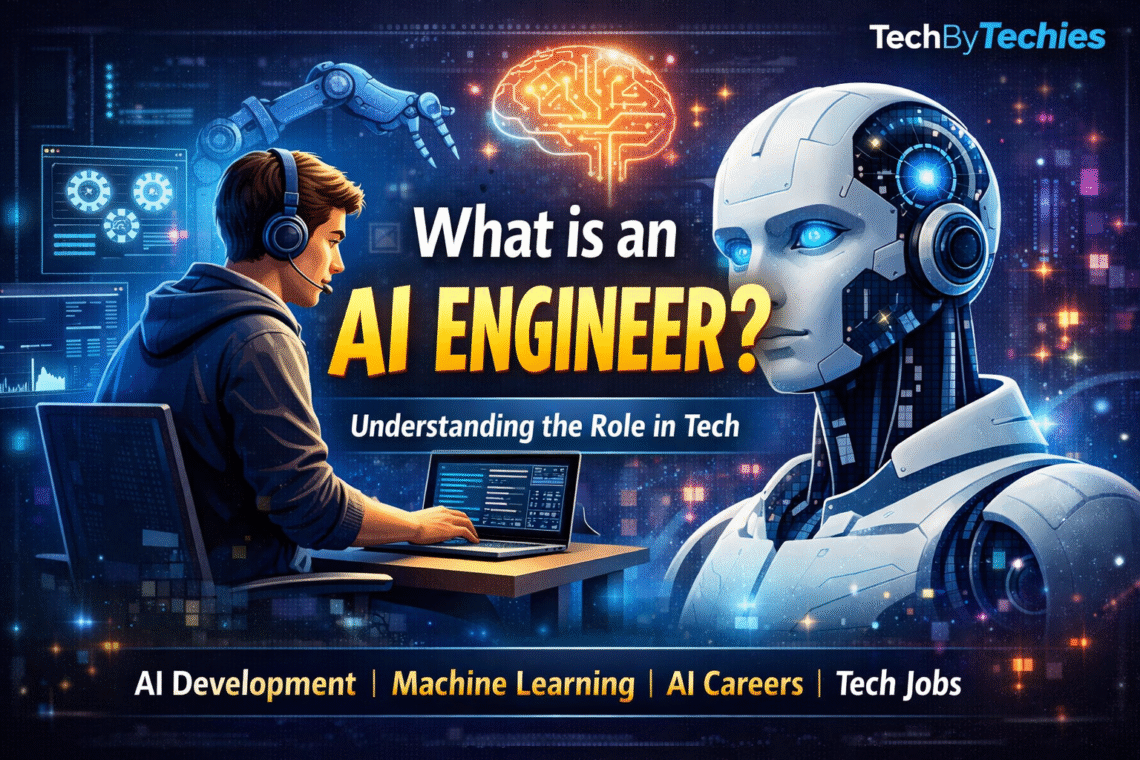
An AI Engineer is someone who builds, integrates, and ships AI‑powered systems into real products.
They don’t just experiment with models — they make AI work in production.
🧠 Why There’s So Much Confusion
AI roles overlap a lot:
- Data Scientists build and analyze models
- Machine Learning Engineers optimize and scale models
- Software Engineers build applications and systems
- AI Engineers sit in the middle and do a bit of all of these
Many companies reuse titles loosely, so the same job might be called “ML Engineer” in one place and “AI Engineer” in another.
🔍 What an AI Engineer Actually Does
An AI Engineer focuses on turning AI ideas into usable products. Typical responsibilities include:
1. Integrating AI into Applications
Connecting AI models (LLMs, vision models, recommendation engines, etc.) into:
- Web or mobile apps
- APIs and microservices
- Internal tools and workflows
2. Working with Pre‑Trained Models
Instead of training everything from scratch, they usually work with:
- Hosted APIs (OpenAI, Anthropic, Google, etc.)
- Open‑source models (Hugging Face, local LLMs)
- Fine‑tuned or custom models provided by an ML team
3. Building AI Features
Examples of what they ship:
- Chatbots and copilots
- Smart search and semantic retrieval
- Recommendation systems
- Voice or multimodal assistants
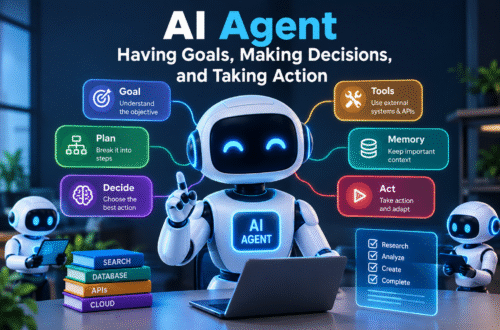
- AI agents that can take actions
4. Managing Data Flow
Designing how data moves between:
- User input (text, voice, images, events)
- The AI model (prompts, context, tools)
- The application output (responses, actions, UI)
5. Deployment, Reliability, and Scaling
Making sure AI systems:
- Run efficiently and stay within budget
- Handle real traffic and edge cases
- Are observable (logging, metrics, tracing)
- Fail gracefully when models or APIs misbehave
🧩 AI Engineer vs Other Roles
Clarifying the differences helps a lot.
AI Engineer vs Data Scientist
- Data Scientist → Focuses on analysis, experimentation, and model development
- AI Engineer → Focuses on productizing and integrating those models
You can think of Data Scientists as asking: “What model works best?” and AI Engineers as asking: “How do we make this usable by thousands of users?”
AI Engineer vs Machine Learning Engineer
- ML Engineer → Deep focus on training, optimizing, and managing ML pipelines
- AI Engineer → Broader focus on building features and systems around models
In some teams, ML Engineers are closer to the modeling side, while AI Engineers are closer to the application side.
AI Engineer vs Software Engineer
- Software Engineer → Builds systems and applications in general
- AI Engineer → Builds systems with intelligence built in
An AI Engineer still writes “normal” software — APIs, services, frontends — but with AI as a core building block.
🛠️ Core Skills for AI Engineers
AI Engineering is a hybrid role. You don’t need to be a researcher, but you do need a strong foundation in both software and AI.
💻 Programming Fundamentals
- Python (most common in AI/ML)
- JavaScript/TypeScript (for AI‑powered web and full‑stack apps)
- Working with REST and GraphQL APIs
- Building and consuming backend services
🤖 AI & ML Basics
- How modern models work at a high level (LLMs, embeddings, classifiers, etc.)
- Prompt engineering and prompt design
- Fine‑tuning and RAG (Retrieval‑Augmented Generation) concepts
- Understanding model limitations, bias, and failure modes
🧱 System & Product Design
- Designing scalable, maintainable systems
- Working with databases, queues, and caching
- Designing user flows around AI responses (e.g., review, feedback, correction)
☁️ Tools & Platforms
- Cloud platforms (AWS, GCP, Azure, or serverless platforms)
- Vector databases (for semantic search and RAG)
- Orchestration frameworks like LangChain, LlamaIndex, or custom toolcalling setups
🔄 Real‑World Engineering Mindset
- Handling edge cases and bad inputs
- Observability, monitoring, and alerting
- Latency and performance tuning
- Cost awareness — optimizing tokens, calls, and infrastructure
🧪 A Real‑World Example
Imagine you’re building an AI‑powered search platform.
An AI Engineer might:
- Crawl, scrape, or ingest content (websites, PDFs, docs)
- Clean and chunk the data
- Convert it into embeddings using a model
- Store those embeddings in a vector database
- Implement a query pipeline that retrieves relevant chunks
- Integrate an LLM to generate answers grounded in that context
- Build a UI and API so users can search and interact
- Deploy the whole system and monitor quality, latency, and cost
This is not just “doing ML” or just “building a backend” — it’s the combination that defines AI Engineering.
📈 Why the AI Engineer Role Is Exploding
AI Engineers are in high demand because:
- Companies don’t just want models — they want products powered by those models
- AI has to integrate with existing systems, data, and workflows
- Powerful APIs have made advanced AI accessible to any competent engineering team
In other words:
- The bottleneck is no longer “Can we build a model?”
- The bottleneck is “Can we use AI effectively in our product?”
That’s exactly where AI Engineers come in.
⚠️ Common Misconceptions
Let’s clear up a few myths:
- ❌ “AI Engineers must build models from scratch.”
Most don’t. They work with existing models and infrastructure. - ❌ “AI Engineers are just prompt engineers.”
Prompting is a tool, not the whole job. - ❌ “AI Engineers only work on chatbots.”
Chatbots are one use case among many.
✅ Reality: AI Engineers are builders who turn AI capabilities into real, reliable products.
🧭 Is AI Engineering for You?
You might enjoy being an AI Engineer if you like:
- Building practical products end‑to‑end
- Working with cutting‑edge tools and models
- Mixing backend engineering with AI
- Solving messy, real‑world problems where there’s no perfect answer
You don’t need a PhD — but you do need curiosity, solid software skills, and a willingness to keep learning.
🏁 Final Thoughts
An AI Engineer is not just a fancy job title. It’s the bridge between AI research and real‑world applications.
As AI continues to evolve, this role will only become more central to how products are built.
So next time someone asks, “What is an AI Engineer?” you can say:
“It’s the person who turns AI into something people can actually use.”