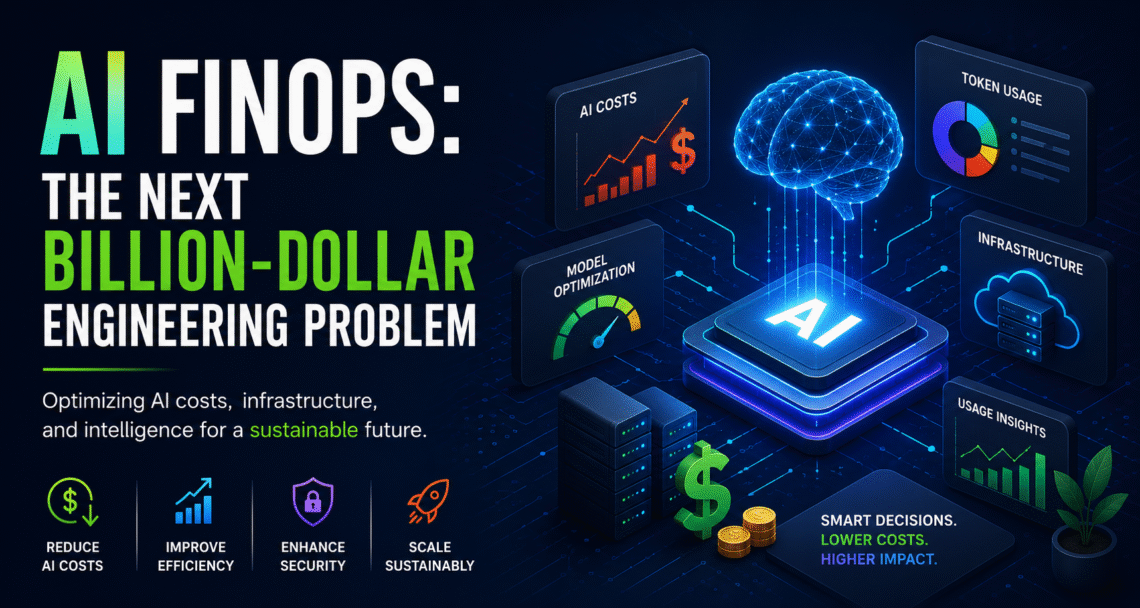
For years, engineering leaders focused on controlling cloud bills, optimizing Kubernetes clusters, and improving infrastructure efficiency. FinOps became a normal part of operating modern software systems.
Now a new cost center is growing faster than most teams expected: AI.
What begins as a simple product decision, like adding an AI assistant or integrating a model API, can quietly become a major financial and operational challenge within months. Many companies are already asking a question they did not expect this early:
Why is our AI bill larger than parts of our core infrastructure bill?
This is the rise of AI FinOps.
The AI Gold Rush Has a Hidden Cost Curve
In the first phase of adoption, most organizations moved quickly. They integrated model APIs, launched copilots, built chat experiences, and embedded AI into customer workflows. Early usage looked affordable, and teams assumed costs would grow in a manageable way.
Then usage patterns changed.
More teams shipped AI features. Customer adoption increased. Product managers added AI to multiple flows. Agents started chaining calls. Context windows expanded. Response quality expectations increased.
At that point, the cost profile changed from linear to unpredictable.
What looked like thousands of requests became millions of model invocations. Token consumption exploded. Budget forecasting became unreliable. Teams discovered that AI pricing behaves very differently from traditional request-response systems.
Why AI Costs Escalate Faster Than Traditional Infrastructure
Classic infrastructure costs are usually tied to fairly stable dimensions like CPU, memory, storage, and network traffic. AI costs add new variables that can multiply quickly:
- Input tokens
- Output tokens
- Context window size
- Model tier selection
- Retry behavior
- Tool-calling depth
- Agent loop behavior
- Concurrency patterns
This means a single user action is no longer a single backend request. One prompt can trigger retrieval, summarization, routing, tool calls, validation passes, and follow-up reasoning.
In production systems, one user interaction can fan out into dozens of model calls. Multiply that by thousands of users, internal automations, and background jobs, and cost growth becomes difficult to control without dedicated engineering effort.
AI Is Becoming Infrastructure, Not Just a Product Feature
Many organizations are now realizing a structural shift:
AI is not merely a feature layer. AI is infrastructure.
And infrastructure always requires operational discipline.
Cloud FinOps emerged because unmanaged cloud usage destroyed predictability. Kubernetes governance emerged because cluster sprawl created waste. Observability optimization emerged because telemetry pipelines became expensive at scale.
AI is now following the same path, introducing new optimization domains:
- Token FinOps
- GPU FinOps
- Inference routing
- Model selection governance
- Workload placement strategy
- AI observability and unit economics
This is no longer optional for scaling teams. It is becoming a core engineering capability.
Why Teams Are Exploring Self-Hosted AI
As API spend rises, many companies are evaluating alternatives such as self-hosted models and private inference infrastructure.
Typical options include:
- Open-source models for targeted workloads
- GPU-backed private inference clusters
- On-prem or VPC-contained model serving
- Hybrid deployment patterns across cloud and internal infra
Popular building blocks often include tools like Ollama, vLLM, Kubernetes orchestration, and NVIDIA GPU platforms, along with models such as Llama, Mistral, Qwen, and DeepSeek.
The motivation is straightforward: reduce recurring per-token spend for high-volume tasks and gain more control over performance, privacy, and predictability.
The Real Trade-Off: Self-Hosting Is Powerful, but Complex
A common misconception is that open-source models automatically mean low-cost AI. In reality, self-hosting shifts spending from API invoices to platform complexity.
Teams must handle:
- GPU fleet planning and capacity management
- VRAM and batch optimization
- Load balancing and request scheduling
- Quantization and model format strategy
- Inference latency tuning
- Multi-tenant isolation and security
- Monitoring, tracing, and incident response
- Model deployment and rollback pipelines
At enterprise scale, this is a serious distributed systems problem. The complexity increases further when real-time response guarantees, high concurrency, and multi-agent orchestration are required.
The Most Practical Direction: Hybrid AI Architectures
For most organizations, the future is not purely API-first or purely self-hosted. A hybrid architecture is often the most cost-effective and operationally resilient model.
Use smaller or local models for high-volume, lower-complexity tasks:
- Classification
- Summarization
- RAG retrieval enrichment
- Content transformation
- Internal workflow automation
- Routing and extraction
Reserve premium frontier models for high-value workflows where quality has direct business impact:
- Complex reasoning
- Strategic analysis
- Advanced coding tasks
- High-stakes customer interactions
- Critical decision-support generation
This tiered approach improves margin while preserving output quality where it matters most.
AI Cost Optimization Is Becoming a Leadership-Level Concern
AI spend can no longer be treated as a hidden engineering line item. It now affects business strategy directly.
Uncontrolled AI usage can:
- Compress startup margins
- Increase forecast volatility
- Create scaling bottlenecks
- Reduce gross profitability
- Slow down product iteration due to budget pressure
As a result, AI cost governance is becoming a shared responsibility across platform engineering, finance, product leadership, and executive teams.
The Rise of Dedicated AI FinOps Functions
Over the next few years, many companies will formalize AI FinOps capabilities the same way they formalized cloud FinOps.
Emerging responsibilities are likely to include:
- Per-feature AI unit economics
- Token and inference observability
- Intelligent model routing policies
- Cost-aware prompt and context design
- GPU utilization optimization
- Capacity planning across API and self-hosted paths
- Guardrails for runaway agent behavior
Organizations that build these capabilities early will move faster with fewer cost shocks.
The Next Billion-Dollar Opportunity
Every company adopting AI will eventually face the same operational question:
How do we scale AI usage without destroying margins?
The teams and platforms that solve this well, through better routing, better inference economics, and better workload orchestration, will shape the next generation of infrastructure tooling.
Just as cloud cost optimization created major platform businesses, AI infrastructure efficiency will likely create a new wave of large engineering companies.
Final Thoughts
The AI industry is entering a phase that resembles the early cloud era. Right now, many organizations still optimize mostly for speed, feature velocity, and market presence.
The next phase will prioritize:
- Efficiency
- Cost control
- Infrastructure ownership strategy
- Sustainable scaling
That is why AI FinOps is emerging as a foundational engineering discipline.
The next billion-dollar engineering problem may not be building a smarter model. It may be building systems that can run AI sustainably, reliably, and profitably at scale.