Artificial intelligence (AI) is becoming an important part of almost every industry, from healthcare and banking to e-commerce, cybersecurity, and transportation. Behind many of these applications is a fundamental machine learning technique known as supervised learning.
Have you ever wondered how your email service identifies spam, how banks detect suspicious transactions, or how an AI system recognizes handwritten digits? These capabilities often rely on machine learning models trained using examples that already contain the correct answers.
Unlike traditional programming, where developers write specific rules for every situation, supervised learning allows computers to identify patterns in historical data and use what they learn to make predictions about new information.
But how does this process work? What is labeled data? Which algorithms are used, and where is supervised learning applied in the real world?
Let’s explore everything you need to know.
What Is Supervised Learning?
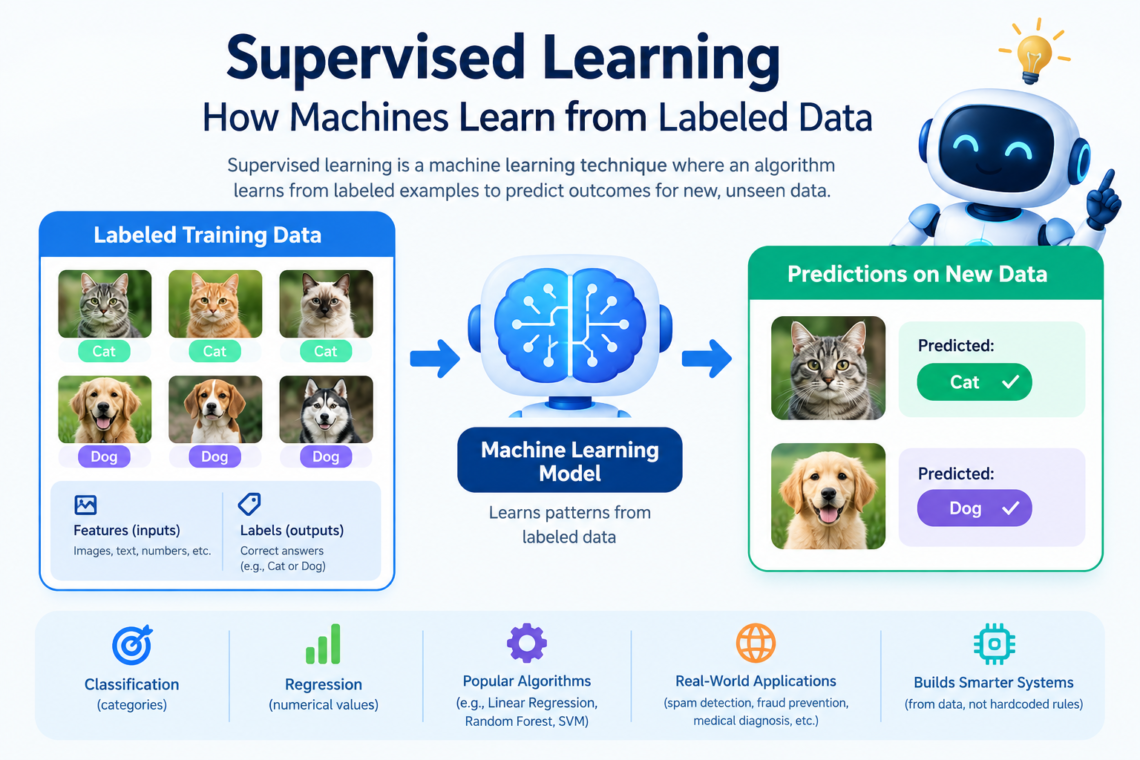
Supervised learning is a type of machine learning in which an algorithm learns from labeled training data to make predictions about new, previously unseen data.
A labeled dataset contains two important elements:
- Features (inputs): The information provided to the machine learning model.
- Labels (outputs): The correct answers associated with those inputs.
During training, the model analyzes examples to identify relationships between the features and their corresponding labels. Once trained, it uses those learned relationships to predict outcomes for new data.
Think of it like a student learning from practice questions that include answer keys. By studying enough examples, the student begins to recognize patterns and can answer questions they have never encountered before.
For example, imagine training a machine learning model to distinguish between cats and dogs. You provide thousands of photographs, with each image labeled either “Cat” or “Dog.”
The algorithm analyzes the images and learns visual patterns associated with each category. After training, you can provide a new photograph, and the model predicts whether it contains a cat or a dog.
The key idea is simple: instead of manually programming every identification rule, we teach the model using examples that already have known answers.
How Does Supervised Learning Work?
Supervised learning follows a structured process, starting with data collection and ending with predictions from a trained model.
Let’s understand each stage.
1. Collect and Prepare the Data
The first step is to collect data relevant to the problem you want to solve.
For example, if you want to build a machine learning model that predicts house prices, your dataset might contain information such as:
- House size
- Number of bedrooms and bathrooms
- Property location
- Age of the property
- Actual selling price
In this example, the house details are the features, while the actual selling price is the label the model needs to learn to predict.
Before training begins, the dataset must be prepared. This may involve removing duplicate records, handling missing values, correcting inconsistencies, and converting information into a format the algorithm can process.
The quality and accuracy of the training data have a significant impact on how well the model performs.
2. Split the Dataset
After preparing the data, it is generally divided into separate groups for training, validation, and testing.
Each group has a different purpose:
- Training set: Used to teach the model by providing labeled examples.
- Validation set: Used during development to compare models, adjust parameters, and improve performance.
- Testing set: Used at the end to evaluate how well the final model performs on data it has never seen.
Common dataset splits include 70/15/15 or 80/10/10 for training, validation, and testing. A simpler 80/20 split can also be used when a separate validation set is not required.
The appropriate split depends on the dataset size and the problem being solved.
This separation helps determine whether the model can generalize, meaning it can make reliable predictions beyond the examples used during training.
For example, a model that performs extremely well on training data but poorly on testing data may have memorized the training examples instead of learning patterns that apply to new information.
3. Train the Model
Once the data is ready, the algorithm begins learning.
During training, the model receives labeled examples and generates predictions. It then compares its predictions with the actual answers to calculate the difference, known as the prediction error.
A mathematical function called a loss function measures this error. The training algorithm adjusts the model’s internal parameters to reduce the loss over repeated iterations.
For example:
- Actual house price: ₹50 lakh
- Model prediction: ₹45 lakh
- Difference: ₹5 lakh
The model uses this difference to improve its predictions during training.
This process continues until the model reaches an acceptable level of performance or meets a defined training limit.
The objective is not simply to memorize the training data. It is to learn useful patterns that can also be applied to new examples.
4. Evaluate Model Performance
After training, the model needs to be evaluated to determine how accurately it makes predictions.
This is where the testing dataset becomes important. The model processes examples it has not previously encountered, and its predictions are compared with the actual answers.
Different evaluation metrics are used depending on the problem.
For classification problems:
- Accuracy
- Precision
- Recall
- F1-score
For regression problems:
- Mean Absolute Error (MAE)
- Mean Squared Error (MSE)
- Root Mean Squared Error (RMSE)
It is important to choose the right evaluation metric.
For example, imagine a bank dataset in which only 0.1% of transactions are fraudulent. A model that classifies every transaction as legitimate would achieve 99.9% accuracy, even though it fails to identify every fraudulent transaction.
This demonstrates why accuracy alone can be misleading. Precision and recall are particularly important when evaluating systems designed to detect rare events, such as financial fraud.
5. Make Predictions (Inference)
Once the model has been trained and evaluated, it can be deployed in an application or software system.
When the deployed model receives new, unlabeled information and generates a prediction, the process is called inference.
For example, a trained house-price prediction model can receive details about a property it has never seen before and estimate its market value.
Similarly, an email filtering system can examine a newly received message and predict whether it is spam or legitimate.
This is how a supervised learning model moves from training examples to practical, real-world applications.
The Two Main Types of Supervised Learning
Supervised learning problems are generally divided into two main categories: classification and regression.
Both approaches learn from labeled data, but they predict different types of outputs.
1. Classification
Classification is used when the model needs to predict a category or class.
Examples include:
- Is an email spam or legitimate?
- Is a financial transaction fraudulent or genuine?
- Is a customer likely to cancel a subscription?
- Does an image contain a cat, dog, or bird?
When a classification problem has only two possible outcomes, it is called binary classification.
When it involves more than two categories, it is known as multiclass classification.
Example: Spam Detection
An email filtering system can be trained using thousands of messages labeled as either spam or legitimate.
The model learns patterns from information such as the sender, subject line, message content, and links.
When a new email arrives, the trained model analyzes it and predicts the category it belongs to.
2. Regression
Regression is used when the model needs to predict a continuous numerical value.
Common examples include:
- House prices
- Monthly sales
- Electricity consumption
- Product demand
- Delivery times
Example: House-Price Prediction
A real estate company can train a model using historical property information, including house size, location, number of bedrooms, and actual selling prices.
After learning from these examples, the model can estimate the price of a new property based on its features.
The difference between the two approaches is straightforward:
Classification predicts a category, while regression predicts a numerical value.
Popular Supervised Learning Algorithms
Different supervised learning algorithms are designed to solve different types of problems.
The best choice depends on the dataset, the prediction task, available computing resources, and the level of accuracy and interpretability required.
Here are seven commonly used supervised learning algorithms.
1. Linear Regression
Linear regression is one of the simplest and most widely used supervised learning algorithms.
It models the relationship between input variables and a continuous numerical output by fitting a linear equation to the data.
For example, a real estate company might use linear regression to estimate house prices based on property size.
It is relatively easy to understand and can be useful when the relationship between the input variables and the target value is approximately linear.
2. Logistic Regression
Despite its name, logistic regression is primarily used for classification problems rather than predicting continuous numerical values.
It estimates the probability that an input belongs to a particular category.
For example, a bank might use logistic regression to estimate whether a transaction is potentially fraudulent or legitimate.
It is commonly used for binary classification and can also be extended to handle multiple classes.
3. Decision Trees
A decision tree makes predictions by following a sequence of decision rules.
It divides data into smaller groups based on selected features until it reaches a prediction.
For example, a loan approval system might evaluate an applicant’s income, credit history, existing debt, and employment status before producing a prediction.
Decision trees are popular because their decision-making process can be relatively easy to understand and explain.
4. Random Forest
Random Forest is an ensemble learning algorithm that combines multiple decision trees to produce a prediction.
Instead of depending on a single tree, it uses several trees trained on different samples and feature selections.
For classification, the trees typically vote on the predicted category. For regression, their predictions are generally averaged.
Combining multiple trees can improve predictive performance and reduce the risk of overfitting compared with relying on a single decision tree.
Random Forest is widely used for classification and regression tasks.
5. Support Vector Machines (SVM)
Support Vector Machines are algorithms primarily used for classification.
They attempt to find a decision boundary that separates different categories while maximizing the margin between them.
For example, an SVM model can be trained to distinguish between two categories of images or classify documents based on their content.
SVMs can also be adapted for regression tasks. They are useful in certain high-dimensional datasets, although their performance depends on the data and the selected parameters.
6. K-Nearest Neighbors (KNN)
K-Nearest Neighbors is an example-based algorithm that makes predictions by examining the closest examples in a dataset.
For classification, it generally assigns the category that appears most frequently among the nearest neighbors.
For regression, it can predict a value by averaging the values of nearby examples.
For example, a KNN model could classify a new product based on the categories of similar products in its dataset.
The algorithm is simple to understand, but predictions can become computationally expensive when working with very large datasets.
7. Naive Bayes
Naive Bayes is a family of probabilistic classification algorithms based on Bayes’ theorem.
It is called “naive” because it makes a simplifying assumption that the input features are conditionally independent given the class.
Although this assumption does not always reflect real-world data, Naive Bayes can still perform effectively in many practical applications.
It is particularly popular for text-related tasks, including spam filtering, document classification, and sentiment analysis.
Supervised Learning Algorithm Comparison
| Algorithm | Main Task | Key Characteristics |
|---|---|---|
| Linear Regression | Regression | Simple and interpretable baseline |
| Logistic Regression | Classification | Estimates class probabilities |
| Decision Tree | Both | Rule-based and relatively easy to interpret |
| Random Forest | Both | Combines multiple decision trees |
| Support Vector Machine | Both | Uses decision boundaries and margins |
| K-Nearest Neighbors | Both | Makes predictions using nearby examples |
| Naive Bayes | Classification | Fast probabilistic classification |
Real-World Applications of Supervised Learning
Supervised learning is used across many industries wherever historical data with known outcomes is available.
Let’s look at some important applications.
1. Healthcare
Healthcare organizations use supervised learning models to support medical image classification, predict patient readmission risks, and assist with the identification of certain medical conditions.
For example, a model trained on labeled medical images can help identify patterns associated with particular abnormalities.
These systems can support medical professionals, but they require appropriate clinical validation and human oversight.
2. Banking and Fraud Detection
Banks and financial institutions use supervised learning to identify potentially fraudulent transactions.
Models are trained using historical transactions labeled as legitimate or fraudulent. They learn patterns that may indicate suspicious activity.
When a new transaction occurs, the model can estimate whether it appears unusual and help investigators prioritize further review.
3. Email Spam Filtering
Email providers use machine learning to classify incoming messages as spam or legitimate.
The model learns from previously labeled emails and identifies patterns in message content, sender information, links, and other characteristics.
This helps email services automatically filter unwanted messages and improve the user experience.
4. E-commerce and Retail
Online shopping platforms use supervised learning for several business applications, including:
- Sales forecasting
- Product categorization
- Customer churn prediction
- Demand forecasting
- Purchase prediction
For example, a retailer can train a model using historical sales data to estimate future product demand and make better inventory decisions.
5. Image and Object Recognition
Supervised learning plays an important role in image recognition and computer vision.
Models can be trained using labeled images to recognize objects, classify photographs, identify manufacturing defects, and process handwritten documents.
Convolutional Neural Networks (CNNs), in particular, have contributed significantly to advances in image recognition.
6. Transportation
Transportation companies use supervised learning to estimate traffic congestion, predict travel times, and support demand forecasting.
These models can analyze historical traffic patterns, weather conditions, road information, and time of day to generate predictions that help improve transportation planning.
Supervised Learning vs. Unsupervised Learning
Supervised and unsupervised learning are two important approaches in machine learning. The main difference between them is the type of data used during training.
Supervised learning uses labeled data, where the correct output is already known for each training example.
Unsupervised learning uses unlabeled data and attempts to identify hidden patterns, relationships, or groups without predefined answers.
Consider an online shopping platform.
It could use supervised learning to predict whether a customer is likely to purchase a product based on historical examples with known purchase outcomes.
The same platform could use unsupervised learning to group customers according to their shopping behavior without assigning predefined customer categories.
Key Differences
| Feature | Supervised Learning | Unsupervised Learning |
|---|---|---|
| Training Data | Labeled | Unlabeled |
| Main Objective | Predict known outputs | Discover hidden patterns |
| Common Tasks | Classification and regression | Clustering and dimensionality reduction |
| Training Guidance | Uses known answers | Finds patterns without predefined answers |
| Example | Spam detection | Customer segmentation |
Both approaches are useful, and the right choice depends on the problem and the available data.
Advantages of Supervised Learning
Supervised learning offers several benefits that make it one of the most widely used machine learning approaches.
- Predictive capabilities: Models learn from historical examples and use those patterns to predict outcomes for new data.
- Measurable performance: Since the correct answers are known, model predictions can be evaluated using established metrics.
- Wide range of applications: It supports numerical predictions, classification, image recognition, and text analysis.
- Continuous improvement: Models can be retrained using additional and higher-quality labeled data.
- Business automation: Predictions can help automate or support tasks such as fraud detection, sales forecasting, and customer analysis.
Limitations and Challenges of Supervised Learning
Although supervised learning is powerful, it also has limitations that organizations need to consider when developing machine learning systems.
1. Requires Labeled Data
Supervised learning depends on labeled training examples.
Collecting and labeling large datasets can require significant time, effort, and domain expertise. In some industries, obtaining accurate labels may also be expensive.
2. Data Quality Problems
The quality of the training data directly affects model performance.
Incorrect labels, missing information, duplicate records, and inconsistent data can lead to unreliable predictions.
A model cannot consistently produce accurate results if it is trained using poor-quality information.
3. Overfitting and Underfitting
Two common challenges in machine learning are overfitting and underfitting.
Overfitting occurs when a model learns the training data too closely, including unnecessary details and noise. As a result, it may perform well on training examples but poorly on new data.
Underfitting happens when a model is too simple to capture important patterns, resulting in poor performance even on the training data.
Techniques such as regularization, cross-validation, and careful model selection can help reduce these problems.
4. Bias in Training Data
If historical training data contains unfair or unrepresentative patterns, a supervised learning model may reproduce or even amplify those biases.
For example, a recruitment model trained on biased historical hiring decisions could generate unfair recommendations.
Organizations should therefore evaluate their datasets and models for potential bias and fairness issues.
5. Changing Real-World Conditions
A model trained using historical information may become less accurate as real-world conditions change.
This problem is often described as model drift, and it includes two important concepts:
- Data drift: The distribution of input data changes over time. For example, customer purchasing behavior may change significantly.
- Concept drift: The relationship between input features and the target outcome changes. For example, fraudsters may develop new techniques that make previously learned fraud patterns less effective.
Continuous monitoring, evaluation, and periodic retraining can help maintain model performance.
Is Deep Learning a Type of Supervised Learning?
Deep learning and supervised learning are closely related, but they do not mean the same thing.
Supervised learning describes how a model learns, while deep learning describes a type of model architecture that uses neural networks with multiple layers.
A deep neural network can be trained using supervised learning. For example, it can learn to recognize objects by analyzing millions of labeled images.
However, deep learning can also use other learning approaches.
Two important examples are:
- Self-supervised learning: A model generates learning signals from the data itself. For example, a language model may learn by predicting missing or next words in a sentence. This approach is widely used when pretraining large language models.
- Reinforcement learning: A model learns through interactions with an environment, receiving rewards or penalties based on its actions.
Therefore, not every supervised learning model uses deep learning, and not every deep learning model is trained through supervised learning.
The Future of Supervised Learning
Supervised learning continues to play an important role in modern artificial intelligence. As machine learning technology evolves, several developments are influencing how supervised models are created and used.
Some important trends include:
- Improved data labeling: Better tools and workflows are making it easier to prepare high-quality training datasets.
- Deep learning integration: Advanced neural networks continue to expand the capabilities of supervised learning in image recognition, speech processing, and language applications.
- Automated Machine Learning (AutoML): Automated tools are simplifying parts of model selection, training, and parameter tuning.
- Human-AI collaboration: Machine learning predictions increasingly support human decision-making in fields such as healthcare, finance, and engineering.
- Responsible AI: Privacy, fairness, transparency, and reliability are receiving greater attention throughout the development and deployment of machine learning systems.
As organizations gain access to more data and improved computing resources, supervised learning will remain an important technique for building practical AI applications.
Final Thoughts
Supervised learning is one of the fundamental techniques behind modern machine learning. By learning from labeled examples, computers can identify patterns, understand relationships between data, and make predictions about information they have never encountered before.
From spam filtering and financial fraud detection to house-price prediction and medical image analysis, supervised learning supports a wide range of real-world applications.
Although it requires reliable labeled data and careful model evaluation, its ability to learn from examples makes it an essential part of today’s AI ecosystem.
The central idea is simple: provide a machine learning model with examples and their correct answers, allow it to learn the underlying patterns, and use that knowledge to make predictions about new data.
Understanding supervised learning is an important first step toward exploring more advanced machine learning concepts, including unsupervised learning, reinforcement learning, and deep learning.